
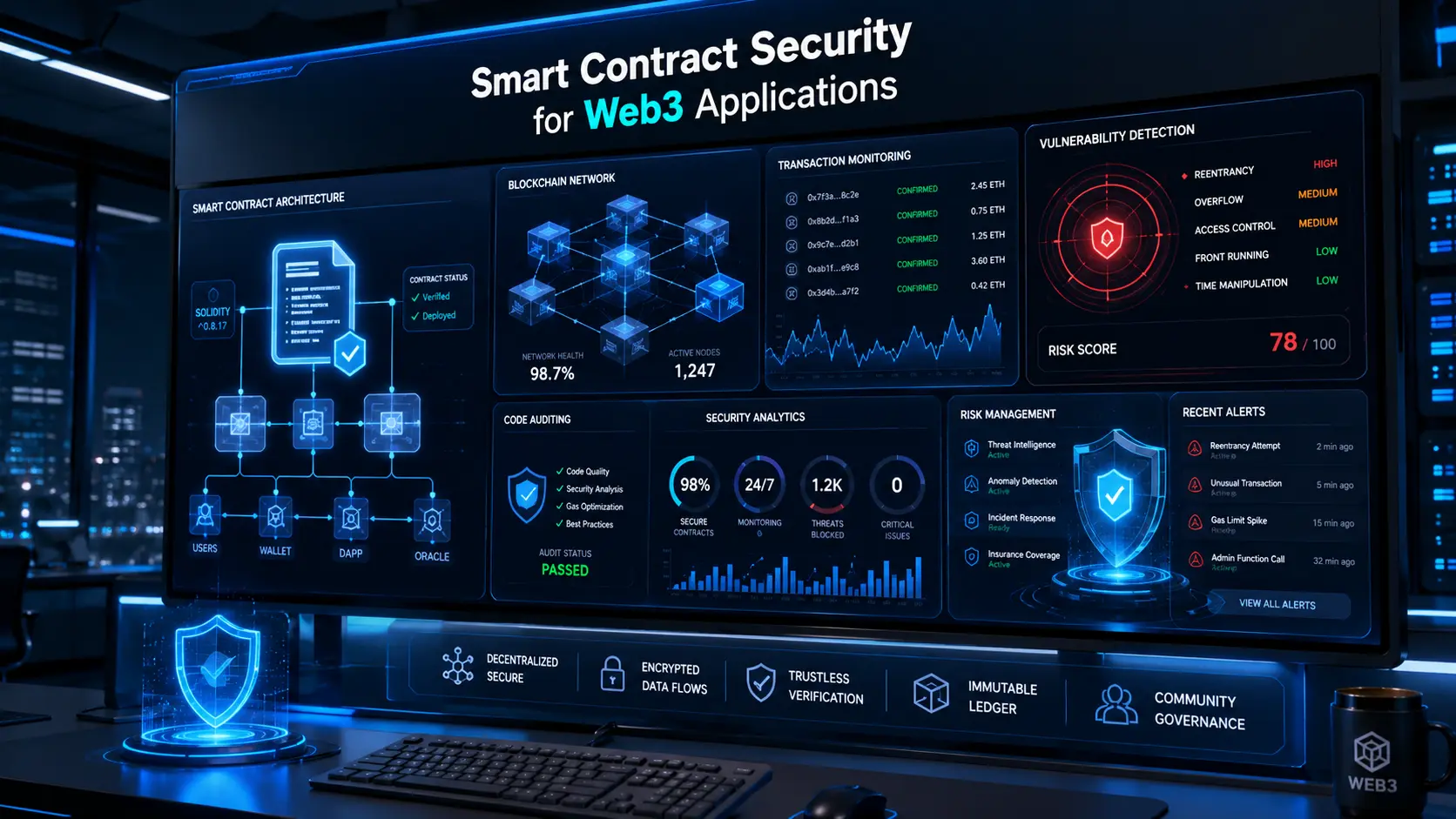
7 Powerful Smart Contract Security Risks to Avoid Now

[toc]
Smart Contract Security: Common Risks Every Web3 Project Should Avoid
Smart contract security is not a final step before launch. It is the foundation that everything else in a Web3 project is built on — and the consequences of getting it wrong are fundamentally different from the consequences of a security failure in traditional software.
In conventional software development, a vulnerability discovered after deployment can be patched. A database can be rolled back. A server can be taken offline while a fix is prepared. These options do not exist in blockchain development. Once a smart contract is deployed to a public network, the code is immutable. A vulnerability that exists at deployment will exist forever, and any attacker who finds it before you do can exploit it without warning and without any possibility of reversal.
The history of DeFi is full of protocols that were technically sophisticated, economically interesting, and catastrophically insecure. Not because the teams building them were incompetent, but because they treated security as something to address after the core functionality was working — rather than as a design constraint that shapes every architectural decision from the beginning.
This guide covers the most critical smart contract security risks that Web3 projects face, the specific patterns that prevent them, and the common mistakes that leave protocols exposed even when developers think they have done the work.
Short Answer
Smart contract security is the practice of auditing, testing, and designing on-chain code to prevent unauthorized access, logic flaws, and financial exploitation. Because smart contracts are immutable after deployment, security must be built in from the design phase using patterns like Checks-Effects-Interactions, strict access controls, and comprehensive third-party auditing. The most effective approach combines automated scanning tools with manual security reviews to eliminate vulnerabilities like reentrancy, overflow errors, and oracle manipulation before any code goes live on a public network.
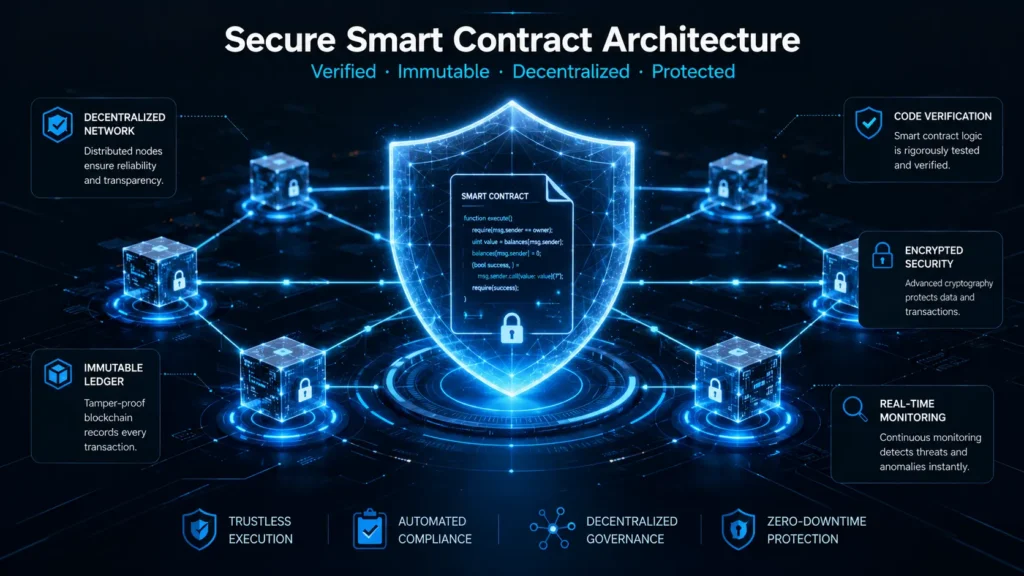
Why Smart Contract Security Determines Whether Your Protocol Survives
The stakes in smart contract security are higher than in almost any other area of software development. Understanding why helps clarify the level of rigor required.
Traditional software vulnerabilities are serious, but they exist within a system that has recovery mechanisms. A company can patch a bug, compensate affected users, restore from backup, and continue operating. The damage is real but bounded and recoverable.
Blockchain operates differently. Transactions are irreversible by design. Code deployed to mainnet cannot be modified. Funds drained from a protocol cannot be recovered through any technical mechanism — only through social coordination, legal action, or the unlikely cooperation of the attacker. Projects that experience significant exploits rarely recover their reputation, even if the financial loss is manageable.
Beyond the immediate financial risk, smart contract security failures affect every stakeholder. Users who trusted the protocol with their funds lose them. Investors lose confidence in the project and the broader ecosystem. Regulatory scrutiny increases. And the team that built the protocol carries the reputational damage of having shipped insecure code into a high-stakes financial environment.
The economics of smart contract security are also straightforward in a way that is unusual in software development. The cost of a professional security audit — typically measured in tens of thousands of dollars — is small relative to the total value locked in even a moderately successful DeFi protocol. And the cost of an exploit is always larger than the cost of the audit that would have prevented it.
Smart contract security is not a cost center. It is the most direct form of risk management available to a Web3 project.
If your team is also building AI-powered automation alongside your Web3 infrastructure, see our guide on RAG system development: /rag-system-development-business-knowledge
The Secure-by-Design Philosophy
The most important shift in smart contract security thinking is moving from treating security as a review step to treating it as a design constraint.
Secure-by-design means that security considerations shape architectural decisions from the beginning — before a single line of production code is written. It means asking not just “does this function work?” but “what happens if a malicious actor calls this function in an unexpected sequence?” and “what is the worst-case outcome if this assumption about external behavior turns out to be wrong?”
In practice, this involves several principles that experienced blockchain security engineers apply consistently.
Modular architecture breaks complex contract logic into smaller, isolated components. When each module has a clear, limited responsibility, the potential impact of any single vulnerability is contained. A flaw in one module does not automatically compromise the entire system.
Zero-trust assumptions treat every external input and every external contract call as potentially malicious. Rather than assuming that callers will behave as expected, secure contracts validate every input and handle unexpected behavior explicitly.
Governance controls distribute administrative authority rather than concentrating it in a single private key. Multi-signature requirements for critical operations mean that no single point of failure — a compromised key, a disgruntled team member, a social engineering attack — can take down or drain the protocol.
7 Critical Smart Contract Security Risks and How to Prevent Them
1. Reentrancy Attacks
Reentrancy is one of the most destructive vulnerabilities in the history of blockchain development. The DAO hack of 2016, which resulted in the loss of roughly 60 million dollars worth of Ether and ultimately led to the Ethereum hard fork, was a reentrancy attack.
The vulnerability occurs when a contract makes an external call to another contract before updating its own internal state. A malicious contract receiving that call can re-enter the original function before the state update completes — effectively calling the withdrawal or transfer function multiple times before the balance is decremented.
Prevention requires strictly enforcing the Checks-Effects-Interactions pattern. Every function should first validate its preconditions (Checks), then update internal state (Effects), and only then make external calls (Interactions). State updates must always happen before external calls, never after. OpenZeppelin’s ReentrancyGuard provides an additional protective layer for functions where external calls are unavoidable.
2. Integer Overflow and Underflow
Integer overflow occurs when an arithmetic operation produces a result larger than the maximum value a variable type can store, causing it to wrap around to a very small number. Underflow is the reverse — a subtraction that goes below zero wraps to the maximum value. Both can corrupt accounting logic in ways that are exploitable.
Modern Solidity (version 0.8.x and above) includes built-in overflow and underflow protection that causes transactions to revert automatically. However, code using the unchecked keyword, custom assembly, or older compiler versions is still vulnerable.
Prevention means using a current Solidity compiler, avoiding unchecked blocks unless the performance benefit is clearly necessary and the arithmetic is demonstrably safe, and using audited math libraries like OpenZeppelin’s SafeMath for any custom numerical operations.
3. Front-Running and Oracle Manipulation
In decentralized finance, transactions are publicly visible in the mempool before they are confirmed. Sophisticated actors monitor this mempool and can submit competing transactions with higher gas fees to execute ahead of a target transaction — a practice called front-running.
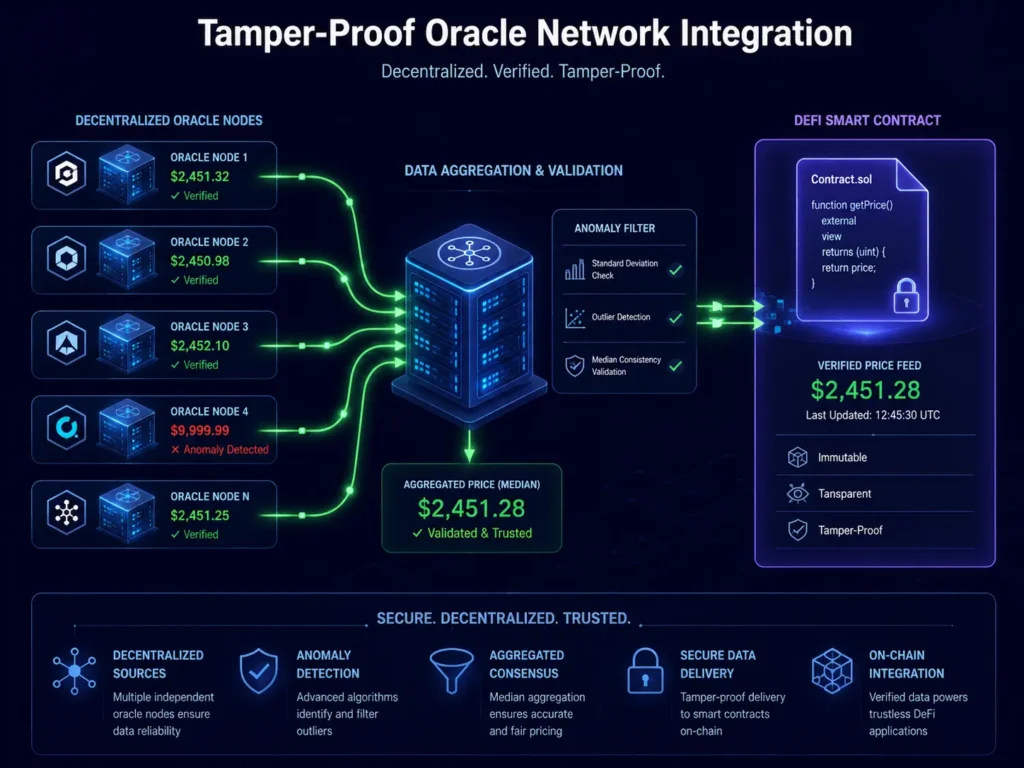
Oracle manipulation is a related vulnerability. Many DeFi protocols depend on price oracles to determine asset values. If those oracles rely on a single data source or a source that can be temporarily manipulated through flash loans, an attacker can distort prices momentarily to exploit the protocol.
Prevention for oracle manipulation involves using decentralized oracle networks with multiple independent data sources. Chainlink’s decentralized oracle network aggregates data from multiple sources and is resistant to single-point manipulation. For front-running, commit-reveal schemes and transaction ordering protections provide meaningful mitigation.
4. Overly Permissive Access Controls
Administrative functions — the ability to mint tokens, adjust fees, pause the protocol, or upgrade contract logic — are high-value targets. If these functions are not properly protected, an attacker who gains access to a privileged account can drain or destroy a protocol instantly.
Single private key control of administrative functions is one of the most common and dangerous patterns in deployed contracts. A single compromised key is all that stands between an attacker and full administrative control.
Prevention involves implementing role-based access control so that different functions require different levels of authorization, and routing critical operations through multi-signature wallets that require multiple independent signers to approve any action. Time-locks on sensitive operations add a second layer of protection by introducing a delay between a governance decision and its execution — giving the community time to detect and respond to malicious proposals.
5. Dependency Vulnerabilities
Most production smart contracts import and build on external libraries and interfaces. If any of those dependencies contain vulnerabilities, the importing contract inherits them. This is the blockchain equivalent of the software supply chain attacks that have affected traditional software in recent years.
Prevention requires using only well-audited, widely used libraries from reputable sources. OpenZeppelin’s contract library is the most commonly used and most thoroughly audited starting point for Solidity development. Pinning dependency versions and auditing any dependency updates before integrating them reduces supply chain risk.
6. Proxy Upgrade Vulnerabilities
Upgradeable proxy patterns allow contracts to be updated after deployment — which seems to solve the immutability problem but introduces its own risks. The relationship between a proxy contract and its implementation contract relies on precise storage slot alignment. If an upgrade changes the storage layout in a way that misaligns slots, it can corrupt all existing contract state.
Prevention requires using established proxy patterns like OpenZeppelin’s Transparent Proxy or UUPS, understanding storage layout implications thoroughly before any upgrade, and testing upgrade scenarios extensively in a fork of mainnet state before executing them.
7. Gas Limit and Denial-of-Service Vulnerabilities
Operations that iterate over unbounded arrays or rely on external calls that can be made to fail can expose a contract to denial-of-service attacks. If an attacker can cause a critical function to consistently run out of gas or revert, they can effectively disable the protocol without directly stealing funds.
Prevention involves avoiding loops over arrays whose length is controlled by external actors, setting explicit gas limits on external calls, and designing critical functions to be atomic and independent of external behavior where possible.
Smart Contract Security Lifecycle Checklist
Action Item | Phase | Purpose
————————-|————————|——————————————
Architectural Review | Pre-Development | Identify structural logic risks early
Static Code Analysis | Development | Catch known vulnerability patterns automatically
Unit Test Coverage | Continuous Integration | Verify individual functions compute correctly
Formal Verification | Pre-Deployment | Mathematical proof of contract correctness
External Security Audit | Pre-Mainnet Launch | Independent manual review from security experts
Post-Launch Monitoring | Runtime | Track real-time threats and anomalous activity
Common Smart Contract Security Mistakes
Skipping the Professional Third-Party Audit
Internal code review is valuable but not sufficient. Security auditors bring external perspective, specialized vulnerability knowledge, and economic attack modeling that internal teams rarely develop without years of focused security work. For any protocol handling real user funds, a professional audit is non-negotiable.
Relying on Security Through Obscurity
Keeping contract source code unverified on block explorers does not provide security. Sophisticated attackers can decompile bytecode and analyze it without source code. Hiding the code only prevents legitimate users and security researchers from verifying your contract’s behavior — it does not stop attackers.
Hardcoding Private Keys or Credentials
Private keys, deployment phrases, or sensitive configuration values that end up in version control or in deployed contract code create immediate and severe security risks. Use environment variables and key management services, never hardcoded credentials.
Treating a Bug Bounty as a Pre-Launch Audit Replacement
Bug bounty programs are a valuable post-launch security layer, but they are not a substitute for pre-deployment audits. A bug bounty invites researchers to find vulnerabilities in live code — code that may already be holding user funds. Audits find vulnerabilities before deployment, when fixing them costs time rather than money.
gnoring Gas Optimization as a Security Concern
Inefficient code that consumes excessive gas is not just expensive for users — it can create denial-of-service vulnerabilities and make certain operations economically impractical to execute. Gas optimization is a performance and a security concern.
Frequently Asked Questions
Q: How long does a professional smart contract audit take?
A: A thorough audit typically takes two to four weeks depending on the complexity and size of the codebase. More complex DeFi protocols with custom economic logic may take longer. Rushing an audit to meet a launch deadline is one of the most common ways projects end up with exploitable vulnerabilities.
Q: Can a bug bounty program replace a pre-launch security audit?
A: No. Bug bounty programs are a post-launch security layer that runs while real user funds are at risk. Audits must happen before deployment to identify and fix fundamental issues before any capital enters the protocol. The two approaches are complementary, not interchangeable.
Q: Do we still need an audit if we use OpenZeppelin libraries?
A: Yes. OpenZeppelin provides thoroughly audited building blocks, but the custom logic your team builds around those blocks — how they are composed, how state is managed between them, how access is controlled — can introduce vulnerabilities that the libraries themselves do not protect against. The audit covers the whole system, not just the dependencies.
Q: What is the difference between static analysis and manual code review?
A: Static analysis uses automated tools like Slither or MythX to identify known vulnerability patterns quickly across the codebase. Manual review involves security engineers tracing through complex economic logic, edge cases, and interaction patterns that automated tools cannot fully model. Both are necessary — automated tools catch common patterns efficiently, while manual review catches nuanced vulnerabilities that require human reasoning.
Q: Can a smart contract ever be completely secure?
A: No software can be guaranteed completely free of vulnerabilities. However, combining rigorous architecture, comprehensive testing, formal verification for critical components, professional audits, and post-launch monitoring brings risk to industry-standard levels that allow protocols to operate safely at scale.
Q: What should I do if I discover a vulnerability in a deployed contract?
A: If the contract has an emergency pause mechanism, activate it immediately to prevent further exploitation. Contact your security team and any auditors who reviewed the code. Communicate transparently with your community about the situation and your response. If funds are at risk, work with blockchain security firms who specialize in on-chain incident response.
Q: How much does a smart contract security audit cost?
A: Audit costs vary significantly based on codebase complexity, audit firm reputation, and current demand. Simple contracts may cost a few thousand dollars. Complex DeFi protocols with custom tokenomics and multiple interacting contracts typically cost significantly more. In every case, the audit cost is small relative to the value that will be entrusted to the contract.
The Bottom Line
Smart contract security is not something you can retrofit after the fact. The immutability that makes blockchain trustworthy is also what makes security failures permanent. A vulnerability that exists at deployment exists forever.
The projects that build safely do not treat security as an obstacle or a cost. They treat it as a design constraint that shapes every architectural decision — from how state is managed to how access is controlled to how external contracts are called. They audit before they launch, monitor after they launch, and continue treating security as an ongoing operational responsibility rather than a box that gets checked once.
The cost of getting this right is a professional audit and the engineering discipline to implement secure patterns consistently. The cost of getting it wrong is a protocol that can be drained in a single transaction, with no technical recourse and lasting reputational damage.
For any Web3 project handling real user funds, smart contract security is the most important investment you will make.
Ready to Secure Your Smart Contracts?
We design and build secure smart contract systems — with the architecture, auditing process, and security patterns that protect your protocol and the users who trust it.
More Blog

The Ultimate Figma to Code Workflow in 7 Proven Steps
Let's be honest. How many times have you seen a design that looked absolutely stunning in Figma, only…

Prevent Double Bookings: 5 Proven Strategies
If your booking platform has ever confirmed two customers into the same time slot, you already know what…
RAG System Development: Powerful Business AI Guide 2026
[toc] How RAG System Development Helps Businesses Use AI with Internal Knowledge Bases RAG system development is solving…