
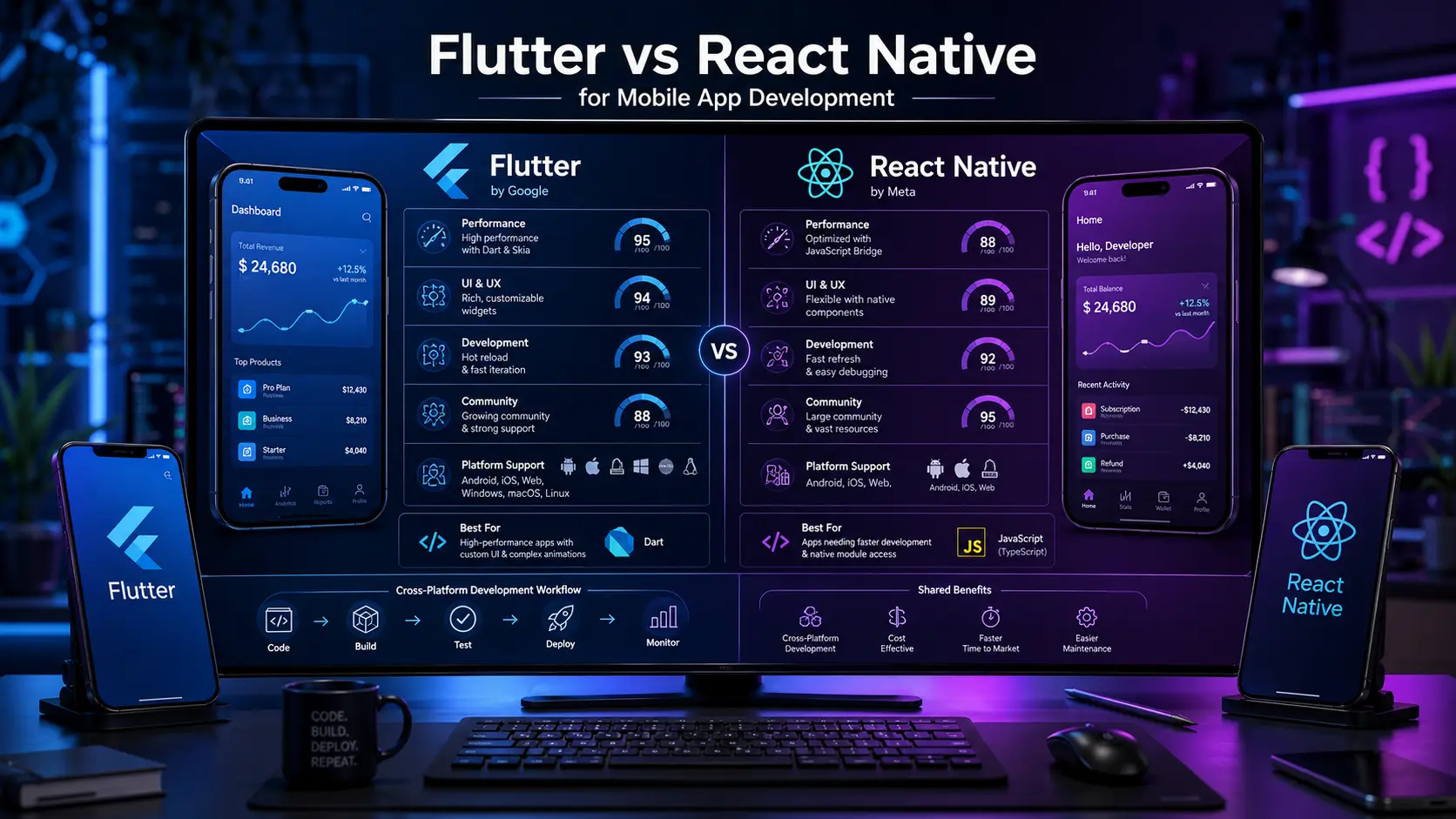
Flutter vs React Native: 7 Powerful Differences in 2026

[toc]
Flutter vs React Native: Which Is Better for Your Mobile App?
Key Takeaways: Quick Summary for Technical Directors
The Rendering Split: React Native invokes real native platform components via an asynchronous JavaScript/TypeScript bridge. Flutter bypasses native widgets entirely, painting every pixel directly onto a canvas using its own high-performance engine (Skia/Impeller).
Developer Velocity: React Native integrates seamlessly with existing web-focused React engineering structures, maximizing code reuse. Flutter offers a unified widget layout architecture with exceptionally fast hot-reload mechanics.
Performance Benchmark: Flutter compiles directly to machine-level ARM/x64 binaries, sustaining stable 60–120fps metrics for heavy animations. React Native is highly efficient for standard CRUD operations but can hit bottleneck constraints during heavy data-bridge transfers.
Long-Term Risk: Both frameworks are supported by tech giants — Google for Flutter and Meta for React Native — and maintain expansive package ecosystems, eliminating framework abandonment risks.
Introduction: The High-Stakes Mobile Stack Decision
In the competitive landscape of mobile application development, the choice between Flutter vs React Native is no longer just about picking a language — it is a strategic business decision that directly impacts your time-to-market, long-term maintenance costs, and overall user experience quality. Business owners and CTOs constantly face the dilemma of choosing between Google’s high-performance UI toolkit and Meta’s battle-tested JavaScript ecosystem, and there is no universally correct answer without deeply understanding both sides.
Both frameworks promise “write once, run anywhere” efficiency, yet they operate on fundamentally different architectures that suit different project scopes and business goals. Whether you are a startup building your first MVP or an established SaaS provider migrating to a mobile-first experience, understanding the technical trade-offs is essential to avoid accumulating unnecessary technical debt down the road. This guide cuts through the marketing hype to provide a consultant’s perspective on how these technologies align with your specific growth goals and operational requirements.
The Flutter vs React Native conversation has evolved significantly over the past few years. Flutter, originally released by Google in 2018, has rapidly matured into a production-ready framework trusted by brands like BMW, eBay, and Alibaba. React Native, backed by Meta since 2015, powers applications for Facebook, Instagram, and Shopify. Neither framework is a compromise — both are enterprise-grade solutions with distinct strengths. Understanding those strengths is the foundation of making the right architectural call.
Quick Answer: Flutter vs React Native — Which Is Better?
Flutter is generally superior for high-fidelity, custom-designed interfaces where consistent performance across all target devices is the top priority, thanks to its compiled native machine code and independent rendering engine. React Native is the industry standard for organizations with an existing JavaScript or TypeScript team, offering faster integration with web codebases and access to a massive library of pre-built community components. The Flutter vs React Native decision ultimately depends on your team’s existing technology stack, your design requirements, and your need for rapid, cost-effective cross-platform scaling.
1. Why Your Mobile Stack Architecture Impacts the Bottom Line
The decision-making process for your mobile stack has immediate and long-reaching implications for your bottom line. Many companies underestimate how deeply a framework choice ripples through hiring, development timelines, testing infrastructure, and product quality. Before evaluating Flutter vs React Native purely on technical grounds, it is essential to frame the decision within your broader business context.
Cost Impact: Choosing a framework that aligns with your internal team’s existing expertise significantly reduces training time and development costs. A React-heavy team forced to adopt Flutter will face weeks of Dart language onboarding before delivering meaningful output, directly increasing your burn rate.
Scalability: A poorly chosen architecture can become a bottleneck as your user base grows. You need a framework that supports modular, feature-based growth without requiring large-scale refactoring six months into production. Both Flutter vs React Native handle scale well, but through different architectural patterns that need to be planned from day one.
User Experience (UX): Since your app is your product, performance issues, slow rendering, or a non-native feel can lead to higher churn rates and negative App Store reviews. Users have little patience for sluggish interfaces, regardless of how feature-rich your application is underneath.
Maintenance: Long-term support requires a framework with a stable ecosystem, strong community backing, and consistent update cycles. Frameworks that release breaking changes without adequate migration paths create expensive maintenance windows for engineering teams.
Risk Reduction: Selecting a mature technology backed by a major technology organization reduces the risk of framework abandonment and ensures you can recruit experienced engineers to maintain and scale your application years down the line. In the Flutter vs React Native landscape, both frameworks carry strong institutional support, making either a low-risk long-term bet.
2. Understanding the Core Concepts: Two Rendering Philosophies
At a high level, the Flutter vs React Native debate is a study in two fundamentally different rendering philosophies — and that difference has cascading implications for performance, visual consistency, and development experience.
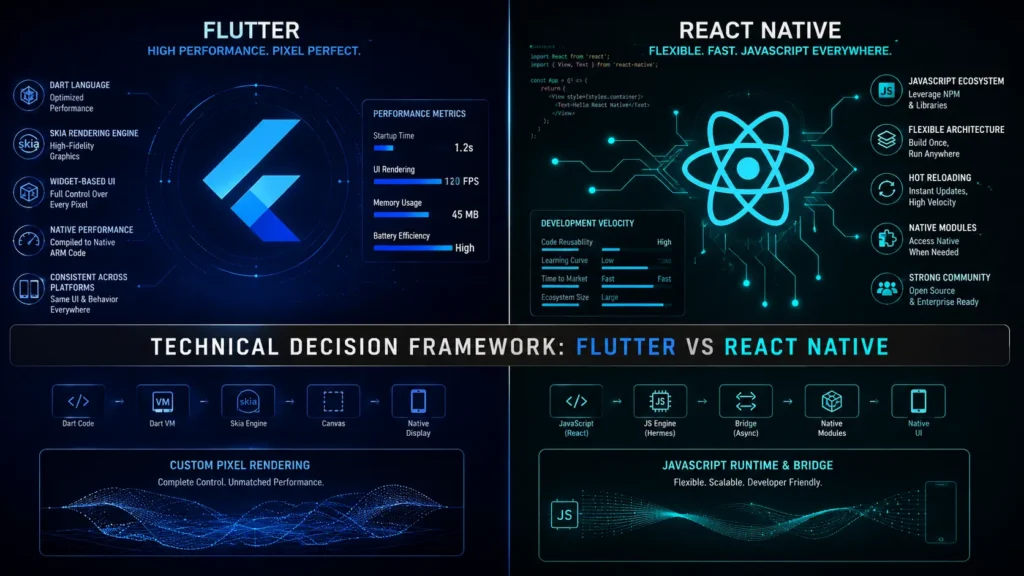
React Native uses a “bridge” approach. It allows developers to write application logic in JavaScript or TypeScript, which then interacts with native platform components through an internal communication layer called the JavaScript Bridge. This architecture means React Native is essentially “native-like” — it maps your UI declarations to actual platform widgets, providing a highly authentic look and feel that users familiar with iOS or Android will immediately recognize.
Flutter, by contrast, uses its own rendering engine — currently Skia, transitioning to the newer Impeller engine — to draw its UI canvas entirely from scratch. Flutter does not invoke standard native platform widgets at all. Instead, it paints every pixel directly onto the container surface provided by the operating system. This approach gives engineering teams complete control over every visual element on screen, guaranteeing that your mobile layout looks and behaves identically across all devices, regardless of whether the target is an older mid-range Android handset or the latest flagship iPhone.
The practical implication of this Flutter vs React Native rendering difference is significant. With React Native, your UI is always subject to the visual updates and behavioral changes that Apple and Google introduce in their native component libraries. With Flutter, your UI is completely independent — your app looks exactly the same regardless of what OS version the user is running.
3. Deep Dive: Architectural Foundations and Code Execution
The architectural gap between Flutter vs React Native goes deeper than just rendering. It fundamentally shapes how your application communicates with device hardware, how animations are processed, and how efficiently the framework handles concurrent operations.
React Native relies on a JavaScript runtime environment (either the V8 engine on Android or JavaScriptCore on iOS), which provides incredible architectural flexibility but introduces a layer of abstraction between your application logic and the underlying hardware. For most standard business applications — CRUD operations, list rendering, form handling, navigation — this overhead is negligible and users will never notice it. However, for CPU-intensive operations like complex animations, real-time data processing, or heavy gesture tracking, this bridge can become a measurable bottleneck.
Flutter compiles directly to native machine code, specifically ARM and x64 binary targets, before the application is even installed on a device. From an engineering perspective, this ahead-of-time (AOT) compilation strategy completely removes the latency of a dynamic serialization bridge between your application logic and the graphics pipeline. This architectural advantage enables Flutter applications to consistently maintain a fluid 60 to 120 frames per second rate, making it the superior choice for applications involving heavy animations, custom drawing operations, or complex gesture recognition systems.
For a deeper technical comparison of both frameworks’ performance characteristics, you can refer to the official Flutter performance documentation and the React Native architecture overview.
It is worth noting that React Native’s new architecture — specifically the JSI (JavaScript Interface) and Fabric renderer introduced in recent versions — significantly narrows this performance gap. For teams evaluating Flutter vs React Native today, React Native’s modern architecture is considerably faster than the legacy bridge model many older benchmarks are based on.
4. Operational Comparison: Development Velocity and Ecosystem Lifespan
For businesses operating under tight delivery schedules, time-to-market is often the most critical evaluation metric. This is where the Flutter vs React Native comparison shifts from technical architecture to practical team dynamics and ecosystem maturity.
React Native benefits immensely from the massive NPM (Node Package Manager) ecosystem — the largest software registry in the world with over two million packages. If your product stack already leverages React for your web platform, the transition to React Native for mobile deployment is remarkably smooth. Your engineering team can share business logic, validation rules, utility functions, and API integration layers across both web and mobile deployments. This code-sharing potential is one of React Native’s most powerful and commercially underappreciated advantages.
Flutter, built around the Dart programming language, introduces a structured widget-tree architecture that encourages clean, composable UI design from the ground up. It features a “hot reload” development utility that is widely regarded as the fastest in the cross-platform ecosystem, allowing developers to see layout and logic changes reflected on a connected device in under a second without recompiling the entire application. This dramatically accelerates the UI iteration cycle during development sprints.
While the initial learning curve for Dart is steeper for engineers coming from a JavaScript or TypeScript background, the language itself is clean, strongly typed, and easy to master within a few weeks of dedicated practice. More importantly, Flutter’s strict widget-based structure produces highly predictable, maintainable codebases — a significant advantage as your product team and feature set expand over time.
From a community perspective, both sides of the Flutter vs React Native ecosystem are active and growing. React Native benefits from the broader JavaScript community, while Flutter has developed one of the most enthusiastic and rapidly growing dedicated developer communities in the cross-platform space.
5. Technical Selection Matrix: Feature-by-Feature Checklist
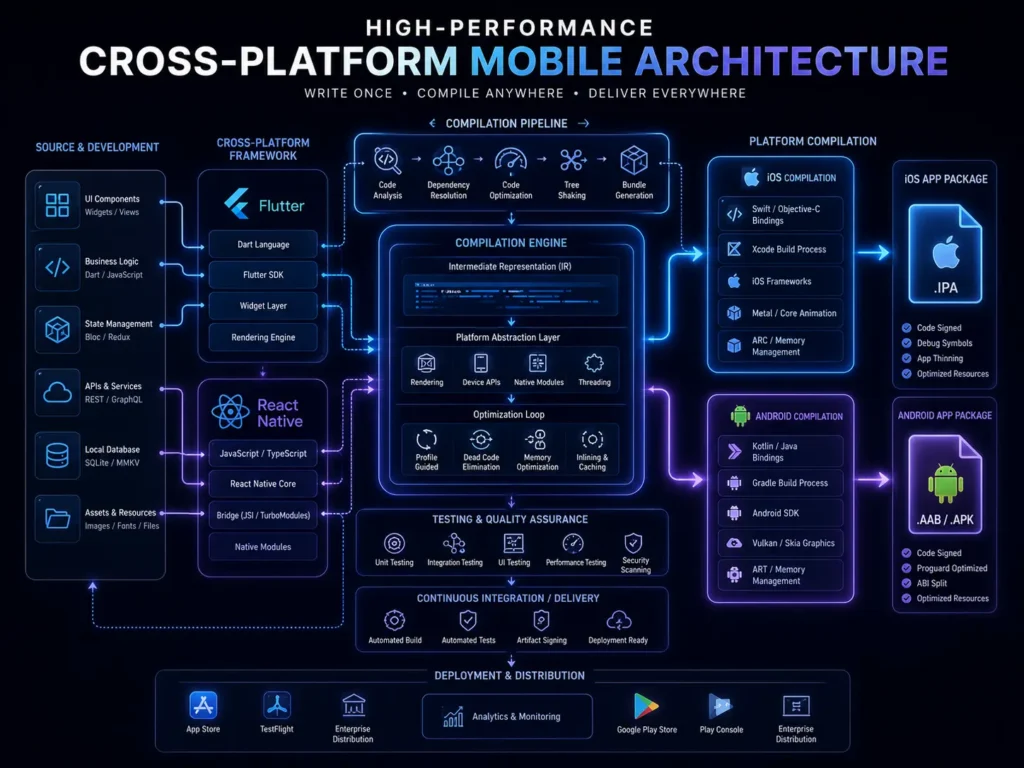
When evaluating Flutter vs React Native for your specific project, a structured feature comparison helps cut through opinion and focus on facts. The table below maps the most business-critical technical dimensions of each framework.
Feature | React Native (Meta) | Flutter (Google)
—|—|—
Primary Language | JavaScript / TypeScript | Dart
UI Rendering Path | Native Platform UI Components | Custom Engine (Direct Canvas Paint)
Talent Pool Breadth | Massive (Shared with global React Web) | Growing (Dedicated Dart developers)
Execution Performance | High (Optimized for standard app logic) | Ultra-High (Compiled to native binary)
Code Modularity | High (Logic sharing with web repositories) | Moderate (Mobile, desktop, embedded systems)
Hot Reload Speed | Fast | Fastest in class
Platform Feel | Authentic native components | Pixel-perfect custom rendering
Best Suited For | Teams leveraging pre-existing Web frameworks | Highly custom, animation-intensive UIs
No single row in this Flutter vs React Native matrix tells the full story. The right framework is the one where your team’s strengths align most naturally with the column that fits your product requirements.
6. Common Cross-Platform Development Mistakes to Avoid
Deploying native applications across mobile market channels without strict structural planning is one of the fastest ways to accumulate crippling technical debt. Whether your team chooses Flutter vs React Native, the following architectural mistakes appear repeatedly across projects of all sizes and budgets.
Ignoring Internal Team Capability: Do not mandate a pivot to Flutter simply because of processing benchmarks if your current development squad consists entirely of senior JavaScript and TypeScript engineers. Retraining costs, reduced velocity, and team morale impact can quickly erode any theoretical performance gains — especially in the first six months of a new framework adoption.
Overlooking Long-Term Maintenance Overhead: Ensure your chosen framework contains mature, well-maintained integration packages for your platform’s specific requirements — such as secure biometric authentication, offline database synchronization, background location tracking, or Bluetooth low-energy communication. A Flutter vs React Native decision made without auditing your third-party dependency requirements can result in significant custom native module development work.
Assuming Cross-Platform Layouts Are 100% Uniform: Even with a unified codebase, development teams must build platform-specific conditional logic to satisfy Apple’s Human Interface Guidelines and Google’s Material Design specifications simultaneously. Skipping this step produces applications that feel subtly “wrong” to experienced mobile users on both platforms.
Pro Tip: Establish automated visual snapshot regression testing inside your CI/CD pipeline from day one. This approach catches accidental platform-specific rendering regressions automatically before updates reach your active user base, saving significant QA time across every release cycle.
Underestimating Automated CI/CD Pipeline Complexity: Mobile application deployments involve strict code signing chains, provisioning profile management, and App Store submission workflows that are meaningfully more complex than web deployments. Failing to configure automated build, test, and distribution pipelines early in the project lifecycle routinely causes severe deployment delays at the worst possible moments.
Relying on Generic Synthetic Benchmarks: Do not make Flutter vs React Native architectural decisions based on published hello-world performance comparisons. Always build a high-load prototype of your application’s most computationally demanding component — your product feed, your real-time dashboard, your animation sequence — and benchmark that specific workload before committing to a framework.
7. Frequently Asked Questions
Q: Is Flutter better than React Native for e-commerce platforms?
A: Both are proven choices for e-commerce. Flutter delivers total visual consistency across product catalog layouts and custom UI animations, which is particularly valuable for premium brand experiences where pixel-perfect design is non-negotiable. React Native, on the other hand, allows your development team to reuse existing cart logic, payment gateway integrations, and transactional state management directly from your web codebase. The Flutter vs React Native decision for e-commerce ultimately comes down to whether your priority is unique visual branding or backend code reuse across web and mobile.
Q: Does a React Native application feel like a real native app?
A: Yes, absolutely. Because React Native maps your component declarations directly onto actual iOS and Android platform UI elements, the compiled output responds and behaves identically to applications written in native Swift or Kotlin. Users will not be able to distinguish a well-built React Native application from a fully native one in standard day-to-day usage scenarios.
Q: Which mobile framework is more cost-effective to build with?
A: Cost-effectiveness in the Flutter vs React Native comparison is entirely team-dependent. If your organization already employs React web engineers, React Native is the more cost-effective choice by a significant margin — your team will be productive within days rather than weeks. If you are hiring a mobile-dedicated team from scratch, Flutter’s structured architecture and Dart’s clean learning curve may actually produce faster long-term results due to reduced maintenance overhead.
Q: Can we migrate an app from React Native to Flutter down the road?
A: Technically possible, but practically it requires a full architectural rewrite rather than a migration. The rendering engines, state management patterns, widget systems, and native module integrations between Flutter and React Native do not translate to each other. This is precisely why the Flutter vs React Native selection during your initial architecture planning phase is so important — reversing the decision later is expensive and disruptive.
Q: Which cross-platform tool provides better support for AI and machine learning integrations?
A: Both Flutter and React Native integrate cleanly with AI and machine learning services through standard REST API or gRPC connections. For on-device inference using TensorFlow Lite or Core ML, both frameworks provide community packages that handle the native bindings. The Flutter vs React Native choice has no meaningful impact on your AI integration capabilities — the decision should rest on your team’s strengths and your UI requirements, not your AI stack.
Q: How do Flutter and React Native handle platform-specific features like camera, GPS, and push notifications?
A: Both frameworks provide well-maintained community and first-party plugins for platform hardware features including camera access, GPS location services, push notification handling, and biometric authentication. React Native’s plugin ecosystem is broader due to its longer market history, but Flutter’s official plugin library (maintained by the Google Flutter team) is highly reliable for all core device capabilities. For either framework in the Flutter vs React Native evaluation, always audit your specific native feature requirements against available plugins before making a final selection.
8. Conclusion: Architecting a Scalable Mobile Presence
The Flutter vs React Native decision is not a question with a universally correct answer — it is a question with the right answer for your specific team, your specific product, and your specific growth trajectory. Flutter wins when you need pixel-perfect visual fidelity, consistent cross-device rendering, and raw animation performance. React Native wins when your team is already invested in the JavaScript ecosystem, your codebase needs to share logic with a web platform, and development velocity is your primary competitive advantage.
What both options share is enterprise-grade maturity, strong institutional backing, and active communities that are continuously pushing each framework forward. Choosing either Flutter or React Native over a purely native approach still delivers significant cross-platform development efficiency gains — the real decision is which cross-platform path aligns best with your operational reality.
At MarkupMarvel, we eliminate system bottlenecks by designing robust, cross-platform engineering blueprints tailored to your product requirements. Translating your digital services into an enterprise-grade mobile application demands comprehensive mastery of component rendering pipelines, secure authentication loops, scalable state management, and low-latency API handling.
Through our specialized Mobile App Development services, our consultants engineer scalable native frameworks optimized for fluent, high-conversion performance. We construct your exact technical deployment map — from converting complex wireframes through high-performance UI/UX Design to Code processes, up to building custom data conduits using advanced API Integration workflows. Whether your Flutter vs React Native decision requires expert validation or your team needs hands-on engineering support to execute the build, we deliver production-ready results.
Whether your mobile application demands a synchronized web backend managed through Rapid MVP Development frameworks or requires secure cloud orchestration layers, we deliver production-ready execution. We protect your application code structures from version conflicts, unoptimized memory allocation, and bottlenecked scaling performance. Learn more about our full range of web and mobile services at MarkupMarvel.com.
Turn Your Mobile Vision Into a Scalable Asset
Do not allow sluggish page loads, layout breaks, and inconsistent platform architectures to bottleneck your product reach. Whether you are still evaluating Flutter vs React Native or have already made your framework decision, our senior technical consultants are ready to build a premium, high-performance cross-platform application engineered for absolute data protection and high user conversion.
More Blog

AI Agents for B2B Lead Nurturing: 7 Proven Workflows
There is a gap that exists in almost every B2B sales funnel — the space between a prospect…


Multi-Vendor Marketplace Architecture: 7 Proven Core Pillars
Building a multi-vendor marketplace is not like launching a standard eCommerce store. It is an entirely different category…

Nginx Redis Caching Optimization: 6 Proven Speed Tactics
Driving a flood of new visitors to your website is supposed to be the win. It only feels…