

Content Optimization for AI Search: 5 Proven Steps to Rank

[toc]
Content Optimization for AI Search: 5 Proven Steps to Rank in AI Overviews
The era of scrolling through ten blue links is quietly coming to an end. B2B buyers, technical decision-makers, and everyday consumers are increasingly skipping the traditional search results page entirely and going straight to Perplexity, ChatGPT, Claude, or Google’s AI Overviews to get a direct answer. Instead of clicking through three or four websites to piece together information, people now expect a synthesized, accurate answer in seconds.
That shift creates both a risk and an opportunity for businesses. If your website is still built purely around traditional keyword SEO, you are likely to lose top-of-funnel traffic as AI Overviews start answering informational questions directly on the results page, with no click required at all. But if you restructure your content the right way, you can become the source these systems actually cite — which puts your brand in front of high-intent users at the exact moment they are looking for an answer.
Getting there requires a real shift in how content gets built. Publishing a long, well-written article is no longer enough on its own. Content optimization for AI search means making your information strictly structured, clearly factual, rich in well-defined entities, and easy for a language model to extract without friction. This guide walks through exactly how to do that.
What Is Content Optimization for AI Search?
Content optimization for AI search is the practice of structuring your website’s information so that AI-driven answer engines — Perplexity, SearchGPT, Google’s AI Overviews — can extract, understand, and cite it accurately. It shifts the focus away from keyword density and toward genuine entity relationships and machine readability.
Practically, this means leading with the answer instead of burying it, using clean semantic HTML headings, integrating real structured data through schema markup, and relying on concise lists and tables rather than long blocks of unbroken prose. Large language models consistently favor sources with high information density, clear factual statements, and unambiguous formatting when deciding what to pull into a generated answer and which source to credit for it.
Why Content Optimization for AI Search Matters for Your Business
Protecting Your Top-of-Funnel Traffic
As AI Overviews answer more informational queries directly on the search results page, the organic traffic that used to flow from those searches is shrinking. Being the cited source inside that AI-generated answer is quickly becoming the only realistic way to stay visible for those queries at all.
Building Real Brand Authority
Answer engines function a bit like a trusted digital consultant for the person asking the question. When Perplexity or SearchGPT names your brand as the source behind a technical answer, that carries an unusual amount of instant credibility with a high-intent buyer who was already evaluating their options.
Strengthening Your Overall Technical Foundation
Structuring content for AI consumption tends to improve traditional SEO and general site accessibility as a side effect. Clean headings, fast-loading pages, and well-organized information help human readers and search crawlers just as much as they help AI systems.
Attracting Further-Along Buyers
Users who click through after seeing your brand cited in an AI answer are often already past the basic research stage. They got the high-level answer from the AI and are visiting your site specifically for implementation detail, pricing, or a buying decision — which tends to make this traffic convert at a noticeably higher rate.
Reducing the Risk of AI Getting It Wrong
When your content is vague or poorly structured, there is a real risk that an AI system misrepresents your pricing, your capabilities, or what your product actually does. Clear, unambiguous, well-structured content significantly reduces the chance of an AI engine getting the facts about your business wrong.
How AI Search Actually Retrieves and Cites Information
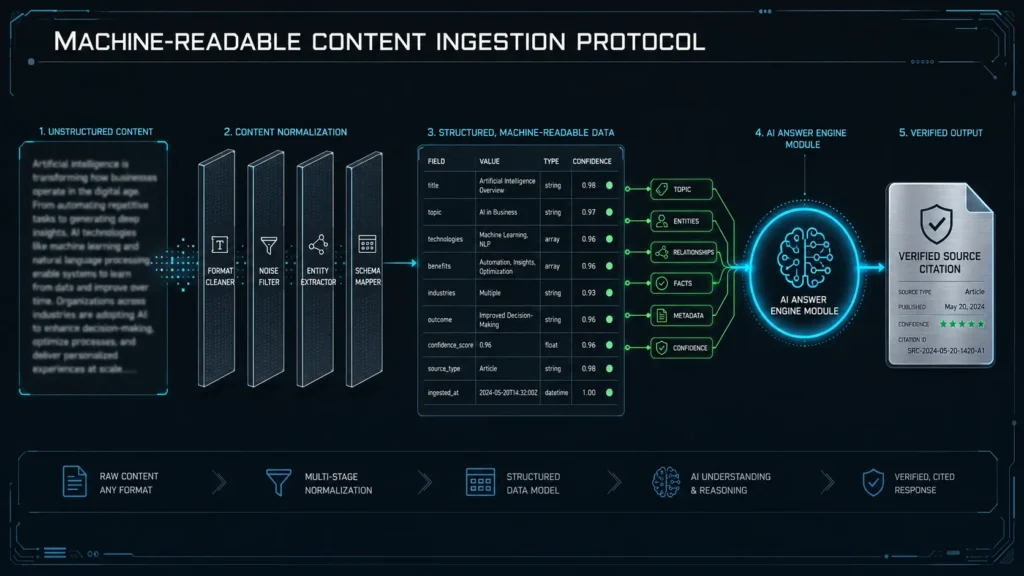
To structure content effectively for AI search, it helps to understand the mechanics behind tools like Perplexity, SearchGPT, and AI Overviews. These systems generally rely on a process called Retrieval-Augmented Generation, or RAG.
When someone asks a question, the AI is not simply recalling an answer from its training data. It behaves more like a fast-moving researcher working through three distinct stages. First, in the retrieval phase, the system queries a live index to pull a set of relevant URLs based on semantic similarity to the question. Second, in the extraction phase, it parses through those pages and isolates the specific paragraphs, data points, or list items that actually answer the question, discarding everything else. Third, in the generation phase, the model weaves the extracted facts into a coherent, conversational answer and attaches citations back to where each fact came from.
Content optimization for AI search is really about making that extraction phase as frictionless as possible. If a language model has to wade through five hundred words of scene-setting before reaching the actual answer, it will move on to a competitor’s page that gets straight to the point. Machine readability has become a core part of what technical SEO means today.
5 Proven Steps to Structure Content for AI Search
Step 1 — Lead With the Answer (BLUF Architecture)
Traditional content writing often buries the actual answer several paragraphs deep, behind a long introduction. AI extraction systems do not have the patience for that. Adopting a “bottom line up front” approach — leading with the answer rather than building up to it — is one of the highest-leverage changes you can make.
In practice, that means placing a direct, factual answer of roughly forty to ninety words immediately beneath any major heading that poses a question. Avoid hedging language like “it depends” or “in our experience” in that opening block — write a clear, declarative statement instead. Save the nuance, edge cases, and deeper context for the paragraphs that follow once the core answer has already been delivered.
Step 2 — Build Around Entities, Not Just Keywords
AI systems do not simply count how many times a keyword appears. They map entities — distinct, well-defined concepts like a specific technology, a company, or a particular process — and track how those entities relate to one another across your content.
If you are writing about a concept like headless architecture, make sure the surrounding text naturally includes the entities a reader would expect to see connected to it — things like Next.js, GraphQL APIs, or edge caching. Place related technical concepts near each other within the same paragraphs rather than scattering them across the page, since proximity signals genuine topical depth to an AI system. When you introduce a piece of jargon, define it immediately rather than assuming the reader or the parsing system already knows it.
Step 3 — Format for Machine Readability
Language models process text by breaking it into tokens, and long, unbroken walls of text create real friction during that process. A few formatting choices make an outsized difference here.
Use proper semantic HTML headings in strict order — never skip from an H2 straight to an H4 — because headings function as the primary map a crawler uses to understand your page’s structure. Present comparison data, pricing information, and technical specifications inside clean tables rather than describing them in paragraph form, since tables are dramatically easier for an AI system to parse accurately. Use ordered lists for any step-by-step process and bullet lists to summarize key features or takeaways, rather than cramming that information into dense prose.
Step 4 — Deliver Genuine Information Gain
Generative AI tools are essentially built to summarize the consensus view across the web. If your page just repeats the same conclusions that are already sitting on the first page of search results everywhere else, there is no real reason for an AI system to single out your page as the one worth citing.
The fix is to include something genuinely original — proprietary data from your own testing, direct quotes from your senior engineers or strategists, or specific real-world case details rather than generic statements. A vague line like “APIs help connect platforms” gives an AI system nothing distinctive to point to. A specific claim like “moving a custom Laravel integration to GraphQL cut sync latency by roughly 80 percent” gives it something concrete and citable.
Step 5 — Get the Technical Foundation Right
None of the content strategy above matters if your website’s underlying code is slow or difficult to crawl. If an AI scraper struggles to load your page or parse your markup, it will simply drop you from consideration before it even gets to evaluate your content.
This means implementing detailed JSON-LD structured data across your site — FAQPage, TechArticle, and Product schema all function as a clear, explicit signal to AI systems about exactly what your content covers. It also means keeping page response times fast, since RAG systems operate under tight timeout windows during real-time retrieval and will abandon a slow-loading page in favor of a faster one. Where possible, rendering your content server-side rather than relying on heavy client-side JavaScript ensures your text is available immediately rather than only after a script finishes executing in the browser.
A Practical Content Optimization Checklist for AI Search
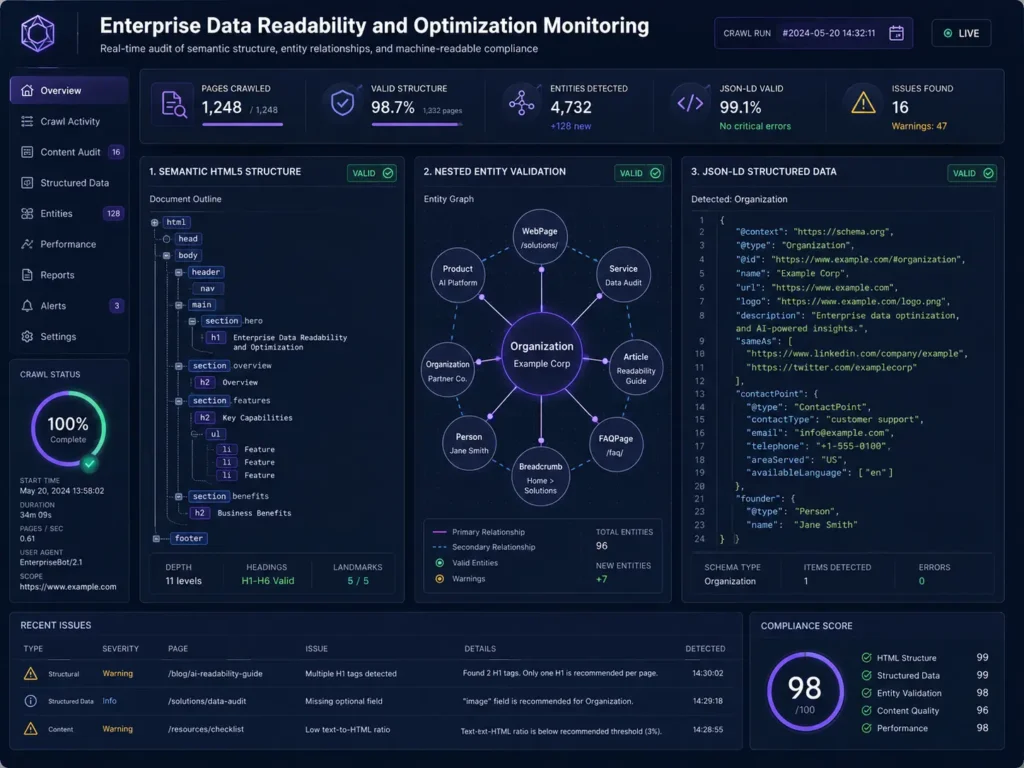
Before publishing or revising a piece of content with AI search in mind, it helps to work through a short, concrete checklist rather than relying on a vague sense that the page “feels” optimized.
– Direct answer block: Is there a clear, factual answer of roughly forty to ninety words placed immediately beneath the relevant heading?
– Clean heading hierarchy: Do your headings move logically from H1 through H2, H3, and beyond without skipping a level anywhere on the page?
– Structured data formatting: Are comparisons, specifications, and pricing details presented in clean tables rather than buried in paragraphs?
– Entity density: Are the related technical concepts and terms a reader would expect actually present and positioned close together in the text?
– Information gain: Does the page include something genuinely original — proprietary data, a direct expert quote, or a specific case detail — rather than just repeating common knowledge?
– Validated schema markup: Has your JSON-LD been checked for errors using a proper validation tool rather than assumed to be correct?
– Factual precision: Are your claims specific, verifiable, and free of vague marketing language that adds words without adding information?
– Fast server response: Does your hosting and rendering setup deliver pages quickly enough to survive the tight timeout windows that AI retrieval systems operate under?
Common Mistakes That Hurt Content Optimization for AI Search
– The slow-build introduction: Making a reader — or an AI crawler — wade through several hundred words of background before reaching the actual point causes extraction systems to abandon your page in favor of one that gets to the answer faster.
– Hiding key information inside PDFs: Modern AI tools can technically read PDF documents, but doing so is computationally expensive and unreliable compared to clean HTML. Move your most important reference content into a proper web page wherever possible.
– Vague, non-descriptive headings: A heading like “Discover the Future” gives an AI system nothing to work with. A heading like “How to Optimize Database Queries in a High-Traffic Laravel Application” gives it real, specific context to extract.
– Old-fashioned keyword repetition: Repeating the same exact phrase over and over no longer helps and can actively hurt how a language model parses your content. Natural language variation reads better to both humans and AI systems.
– Letting technical content go stale: AI systems weight real-time accuracy heavily. Leaving outdated version numbers or deprecated technical details in a guide signals that the page is not being actively maintained, which works against your credibility as a source.
– Overly dense, passive sentence construction: Precision matters, but sentences that are too nested or written entirely in the passive voice make it harder for a parsing system to break the text into clean, extractable chunks. Direct, active sentences read better for both audiences.
How MarkupMarvel Builds AI-Ready Content Architecture
At MarkupMarvel, content optimization for AI search is treated as a structural discipline rather than a writing trick. Every piece of content we build starts with a clear answer-first structure, proper semantic heading hierarchy, and validated structured data — the same foundational requirements covered in our guide on advanced schema markup, which goes deeper into the JSON-LD implementation details that make this kind of content actually machine-readable
We also pay close attention to the technical side of the equation. A perfectly structured article still fails to get cited if the page behind it loads slowly or relies on heavy client-side rendering that AI crawlers struggle to process in time. Pairing strong content architecture with fast, server-rendered infrastructure is what actually moves the needle on AI citation potential — and it is worth reviewing Google’s own documentation on what makes content genuinely helpful and accessible, since that foundation feeds directly into how AI systems evaluate sources
Frequently Asked Questions About Content Optimization for AI Search
Q: What exactly is Answer Engine Optimization?
A: Answer Engine Optimization is the practice of structuring and formatting your website’s content so it can be cleanly crawled, understood, and extracted by AI engines and voice assistants, rather than just ranked as a traditional search result.
Q: How do AI Overviews decide which sources to cite?
A: These systems evaluate candidate pages using retrieval-augmented generation pipelines, favoring sources that show strong machine readability, clear structured data, genuine information gain, and clean, well-organized formatting like tables and lists.
Q: Do we still need traditional SEO if we are optimizing for AI search?
A: Yes. Solid technical SEO — fast crawlability, clean site architecture, a healthy backlink profile — is the foundation everything else is built on. If an AI crawler cannot properly access or parse your site, none of your content optimization work matters.
Q: How does schema markup actually affect visibility in tools like Perplexity?
A: JSON-LD schema acts like a structured, machine-readable summary of what your content actually means. It removes ambiguity for an AI system trying to determine what your page is about, which lowers the friction involved in citing you as a source.
Q: Can we block AI crawlers from accessing our site if we want to?
A: Yes, through standard robots.txt rules. Doing so does remove your content from AI training and retrieval pipelines entirely, which means your brand will not appear in AI-generated answers or citations at all.
Q: How long does it take to see results from this kind of optimization?
A: Technical improvements like fixing structured data or speeding up your server can affect crawl behavior within a few weeks of the next crawl cycle. Building enough topical authority to be consistently cited in AI Overviews typically takes three to six months of sustained work.
Final Thoughts
The shift toward AI-driven search is not a temporary trend that will reverse itself. More queries are being answered directly inside Perplexity, ChatGPT, and Google’s AI Overviews every month, and the businesses that adapt their content architecture now are the ones that will still be visible a year from now.
Content optimization for AI search is not about chasing some entirely new, mysterious discipline. It is about being more disciplined with structure, more honest and specific with facts, and more deliberate about making your information genuinely easy for a machine to extract. The businesses that treat this as a real structural priority — not just a few extra paragraphs bolted onto an existing article — are the ones that will keep showing up as the answer.
More Blog

5 Powerful Custom WordPress Development Tips for Enterprise
Custom WordPress development is the difference between a website that works and a website that works for your…


Make.com vs n8n: 5 Powerful Facts for Business Workflows
Make.com vs n8n is one of the most genuinely useful comparisons you can make before committing to an…

How to Build an MVP: 5 Powerful Steps to Validate Fast
When founders decide to build an MVP, the most common mistake is not moving too fast — it…