
7 Proven Custom Shopify Development Services That Convert
There is a moment every growing e-commerce brand hits. The store is live, sales are coming in, the marketing team is running paid ads, and things feel like they are working. Then a seasonal traffic spike comes through, the site slows to a crawl, the checkout starts throwing errors, and a week's worth of ad spend evaporates into a conversion rate that makes no sense on paper.
[toc]
7 Proven Custom Shopify Development Services That Convert
There is a moment every growing e-commerce brand hits. The store is live, sales are coming in, the marketing team is running paid ads, and things feel like they are working. Then a seasonal traffic spike comes through, the site slows to a crawl, the checkout starts throwing errors, and a week’s worth of ad spend evaporates into a conversion rate that makes no sense on paper.
The store did not fail because the product was wrong. It failed because the foundation was never built for that level of pressure.
Most Shopify stores start on a commercial theme. That is a completely reasonable decision at launch — it is fast, affordable, and gets you to market quickly. But a $200 theme from the Shopify Theme Store is not built to handle the complexity that comes with real scale. It is built to look good in a preview screenshot.
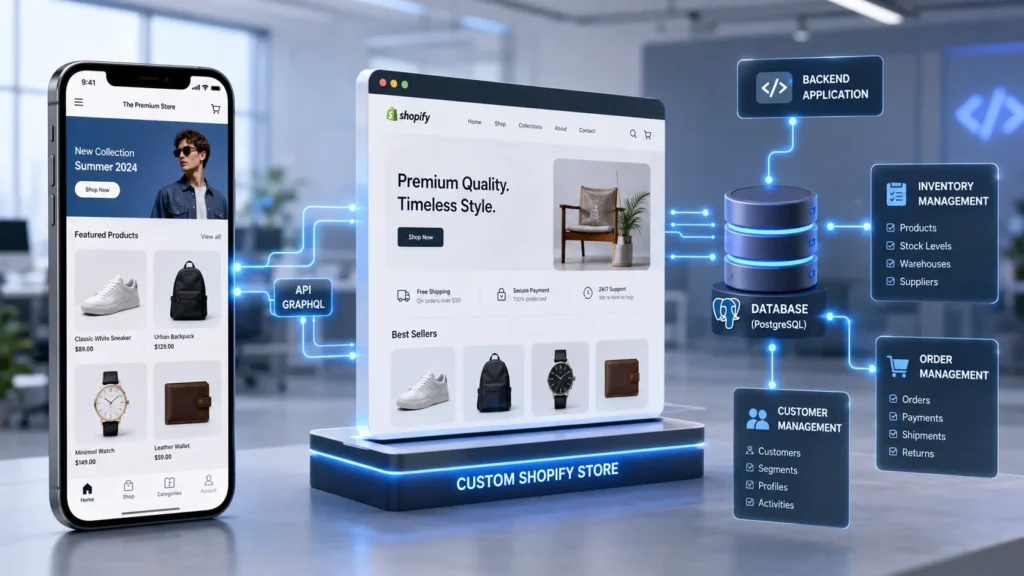
Custom Shopify development is what bridges the gap between a store that works on launch day and a store that works at 10x your current volume, with complex pricing logic, third-party system integrations, and a checkout flow engineered specifically around how your customers actually buy.
At MarkupMarvel, we build Shopify storefronts from scratch. No commercial templates, no page builder shortcuts, no unnecessary app dependencies. Just clean, modular code built around your specific business model — and a storefront your customers will actually want to use.
1. Why High-Volume Brands Outgrow Standard Shopify Themes
Buying a standard Shopify theme at launch is not a mistake. For most early-stage brands, it is the right call — you need to validate the product, test the market, and move fast. A commercial theme lets you do that without a five-figure development bill.
The problem is not the theme itself. The problem is what happens when you try to grow on top of it.
App bloat that quietly destroys your performance
Standard Shopify themes do not do much on their own. To add the features a real store needs — product upsells, custom swatches, advanced reviews, countdown timers, loyalty programs — store owners install apps. Then more apps. Then a few more to fix problems the first apps created.
Every app you install injects JavaScript into your frontend. That JavaScript runs on every page load, whether the feature is being used on that page or not. Your Time to First Byte climbs. Your DOM size balloons. Your Core Web Vitals scores drop. And your conversion rate follows them down.
According to Shopify’s own performance research, a one-second delay in page load time can reduce conversions by up to 7%. At meaningful revenue levels, that is not a rounding error.
Checkout flows that do not match how your customers buy
Commercial themes are designed around a single, generic purchasing journey. If your business operates in the B2B space — with wholesale pricing tiers, net-30 payment terms, minimum order quantities, or gated catalogs — a standard theme cannot handle that logic. You end up building workarounds on top of workarounds, and your customers feel every one of them.
Cart abandonment is rarely about price. It is almost always about friction. When the checkout experience does not match what a buyer expects, they leave.
A storefront that looks like everyone else’s
If you are using one of the top-selling Shopify themes, so are thousands of your competitors. Premium brands cannot afford to look like a dropshipping store. When your visual identity is indistinguishable from the next brand in the category, you compete on price — and that is a race you do not want to run.
Custom Shopify development solves all three of these problems at the architecture level, not with more apps layered on top.
2. What Custom Shopify Development Actually Involves
The term gets used loosely, so it is worth being specific about what real custom Shopify development looks like versus what agencies often mean when they say it.
A lot of agencies call it “custom” when they take a commercial theme and change the colors, fonts, and homepage layout. That is theme customization. It is not custom development, and it carries all the same limitations of the original theme.
True custom Shopify development means starting from a blank file. Our engineers write bespoke Shopify Liquid, HTML5, CSS3, and modern JavaScript from scratch — no commercial theme base, no page builder generating bloated code underneath a clean-looking surface.
What that produces is a theme architecture that exists nowhere else. Every component is built for your specific product catalog, your specific customer journey, and your specific business logic. The codebase contains nothing your store does not use. There is no dead weight, no redundant functionality, no features from someone else’s use case running in the background.
The result shows up in your performance scores, your checkout conversion rate, and the experience your customers have when they land on your store.
3. Figma to Shopify Liquid: Where Design Meets Engineering
Custom Shopify development without strong design direction produces a fast site that nobody wants to use. Strong design without proper engineering produces a beautiful site that falls apart under pressure. The two have to work together from the beginning.
Our process starts in Figma. Before a single line of Liquid is written, we work through high-fidelity wireframes and design prototypes that map out every page, every component, and every interaction state. Product pages, collection pages, cart drawers, checkout flows, mobile navigation — everything is resolved at the design stage, not discovered during development.
Once the design is approved, our frontend engineers translate those Figma files into Shopify Liquid with the same level of precision. We use modern CSS Grid and fluid typography to ensure the layout adapts correctly across every screen size — ultrawide desktop monitors, standard laptops, tablets, and mobile devices on slow connections.
The standard we hold ourselves to: if it is in the Figma file, it is in the live site. Not approximately. Exactly.
This matters because every visual inconsistency between your design and your live store is a signal to customers that something is slightly off. Trust is built in details, and details are where commercial themes consistently fall short.
4. Advanced API Integrations: Connecting Your Store to Your Operation
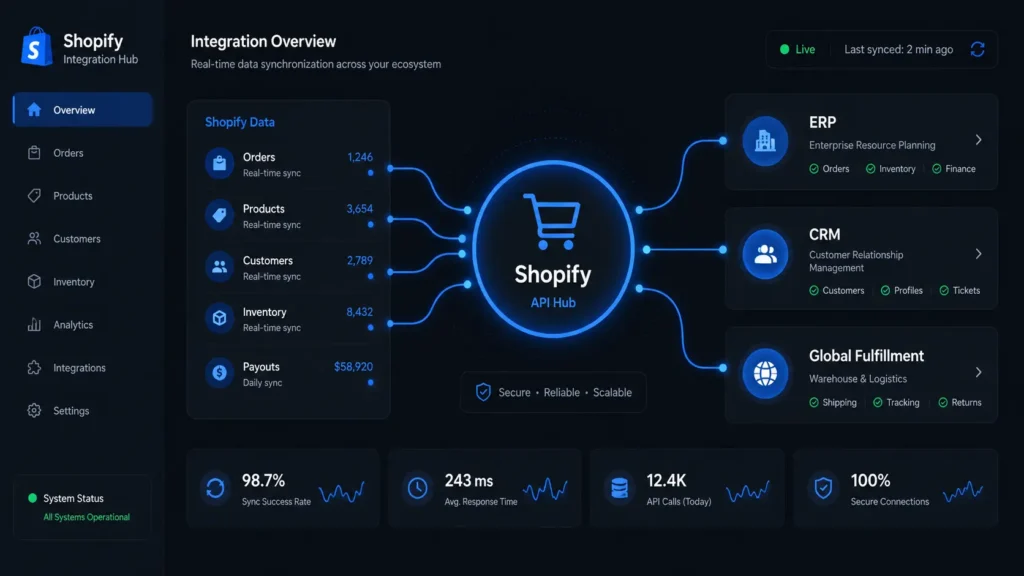
A Shopify storefront does not exist in isolation. For most scaling brands, it is the customer-facing layer of a much larger operational stack — inventory systems, fulfillment centers, CRM platforms, finance tools, customer service software.
When those systems are not properly connected, the gaps show up in ways that hurt the business. Orders that have to be manually re-entered into an ERP. Inventory counts that are always slightly wrong. Customer records split across three platforms with no single source of truth. A returns process that requires five manual steps and still produces errors.
Our custom Shopify development work includes engineering the integrations that eliminate those gaps.
We connect Shopify to ERP systems like NetSuite and SAP, sync order and customer data with CRMs like Salesforce and HubSpot, integrate with third-party logistics providers and fulfillment centers, and build custom API bridges for platforms that do not have native Shopify connections.
These are not plug-and-play app installations. They are engineered integrations — built to handle your specific data structures, your error cases, and your edge conditions. Real-time sync, not batch updates. Clean data flow, not workarounds.
5. Headless Commerce: The Architecture for Serious Performance
For most Shopify stores, a well-built custom Liquid theme — clean code, optimized images, minimal app dependency — delivers the performance they need. For brands operating at enterprise scale, with high concurrent traffic, complex content requirements, or omnichannel distribution needs, there is a ceiling to what a traditional Liquid theme can achieve.
Headless commerce is how you build past that ceiling.
In a standard Shopify setup, the frontend and backend are tightly coupled. Shopify renders your Liquid templates server-side and delivers HTML to the browser. Under high load, or when a page requires pulling data from multiple sources, this process creates latency.
A headless architecture separates them. Shopify handles what it does best — secure checkout, payment processing, inventory management, order fulfillment. A completely separate frontend application, built in React or Next.js, handles what customers see. The two communicate through Shopify’s Storefront API.
What this produces in practice:
Page transitions happen in milliseconds because the browser does not reload the full page — it fetches only the data it needs and updates the relevant components. The experience feels like a native mobile application, not a website.
The same Shopify backend can serve content to your website, your mobile app, a physical retail kiosk, and any other surface simultaneously. One content management workflow, consistent data everywhere.
And because Shopify’s checkout and payment infrastructure remains intact, you keep all the compliance, security, and reliability that comes with it — without the frontend performance constraints.
Your content and marketing teams keep working in the interfaces they already know. Your customers get a storefront that loads faster than anything built on a commercial theme.
6. B2B Shopify Development: Wholesale and Enterprise Commerce
B2B e-commerce has specific requirements that standard Shopify themes are simply not designed to handle. Wholesale pricing, account-based access, net payment terms, minimum order quantities, bulk ordering tools — these are not features you can approximate with a plugin combination.
With Shopify Plus and custom development, we build proper B2B commerce infrastructure.
Gated wholesale catalogs that require account approval before pricing is visible. Customer-specific pricing tiers that apply automatically based on account type or order history. Net-30 and net-60 payment terms integrated into the checkout flow. Minimum order quantity enforcement that works cleanly without confusing the buyer. Quick-order forms designed for buyers who know exactly what they need and want to move fast.
The B2B buyer has different expectations than a retail consumer. They are not browsing — they are purchasing on a schedule, often with specific approval workflows on their end. The storefront experience needs to match that reality, not force them into a consumer checkout flow that was never designed for them.
7. Platform Migration to Shopify: Zero Downtime, No SEO Loss
Replatforming an established e-commerce store is one of the most high-stakes technical projects a brand can undertake. Done wrong, it means lost customer data, broken order histories, and years of organic search rankings wiped out in a single weekend.
We have handled migrations from WooCommerce, Magento, BigCommerce, and custom-built platforms to Shopify and Shopify Plus. The process is methodical, documented at every step, and built around one non-negotiable requirement: nothing gets lost.
Data integrity: Every product, every customer record, every order history is mapped and migrated with validation checks before anything goes live. Encrypted passwords are handled correctly. Historical data is preserved in the format Shopify requires.
SEO continuity: Every URL on your existing store gets a 1-to-1 301 redirect to its counterpart on the new Shopify store. All metadata, structured schema, and canonical tags are transferred. According to Google’s migration guidelines, proper redirect mapping is the single most important factor in preserving organic rankings during a platform change. We treat it accordingly.
Zero downtime: The migration happens in a staging environment. Your existing store stays live until the new store is fully validated and ready. The cutover is planned, tested, and executed during your lowest-traffic window.
Frequently Asked Questions
Q: Why is custom Shopify development worth it over a premium theme?
Premium themes are built to appeal to as many businesses as possible, which means they include code for use cases that have nothing to do with yours. That code loads on every page. Custom Shopify development gives you a codebase built exclusively for your store — nothing unused, nothing unnecessary. The result is faster load times, a cleaner checkout experience, and a storefront that actually reflects your brand.
Q: Can you build complex B2B features on Shopify?
Yes. With Shopify Plus and custom development, we build full wholesale infrastructure — gated catalogs, account-based pricing, net payment terms, MOQ enforcement, and bulk ordering tools. These are engineered features, not plugin approximations.
Q: If we go headless, can our marketing team still manage content?
Yes. We integrate headless CMS platforms like Sanity or Contentful into the frontend so your marketing team has a clean, intuitive editing interface. They can update banners, build landing pages, and publish content without touching code.
Q: How do you handle platform migrations without losing SEO rankings?
We build a complete 1-to-1 301 redirect map before anything goes live, transfer all metadata and structured schema, and validate every redirect after launch. SEO continuity is treated as a migration requirement, not an afterthought.
Q: Do you offer support after the store launches?
Yes. We provide ongoing technical support, security monitoring, performance audits, and app stack reviews. A custom Shopify store is a long-term asset, and we treat the post-launch relationship accordingly.
Q: How long does a custom Shopify development project take?
Timeline depends on scope. A custom Liquid theme build typically runs 6 to 10 weeks. A headless commerce project with API integrations is usually 10 to 16 weeks. We provide a detailed project timeline during the scoping phase so there are no surprises.
Ready to Build a Shopify Store That Actually Scales?
A commercial theme gets you to launch. Custom Shopify development gets you to scale. If your store is generating real revenue and you are starting to feel the ceiling of what your current setup can handle, that is the right time to build properly.
We engineer Shopify storefronts that perform under pressure, convert at a higher rate, and give your team the backend control they need to move fast without calling a developer every time something needs to change.
MarkupMarvel builds e-commerce infrastructure for brands that are serious about growth.
Explore
Other Services We Provide

The Ultimate 7-Step Technical SEO Setup Guide for B2B Growth
A beautiful website that nobody can find is not an asset; it is a liability....
Service Details →
7 Proven Website Revamping Services That Boost Performance
In the digital landscape, a website ages rapidly. A platform built just three to five...
Service Details →
Custom Booking Reservation Systems: 7 Powerful Features
A double booking that results in two customers showing up for the same slot. A...
Service Details →