
E-Commerce Catalog Management: 3 Proven Ways to Scale
Growth in e-commerce comes with a problem most brands do not see coming: the sheer volume of product data.
[toc]
How Strategic E-Commerce Catalog Management Scales High-Volume Shopify and WooCommerce Stores
Growth in e-commerce comes with a problem most brands do not see coming: the sheer volume of product data.
When a store scales from 100 SKUs to 5,000 or 10,000, the operational focus shifts away from selling products and toward simply managing them. Marketing teams get buried in spreadsheets. Developers spend days reformatting broken CSV files. Inventory discrepancies lead to overselling, and overselling leads to the kind of customer experience failures that damage a brand for months.
At this scale, your product catalog is no longer a list of items. It is a complex database that requires structured, disciplined technical governance. Without that governance, even a visually polished Shopify or WooCommerce storefront starts to fail from the inside.
Strategic e-commerce catalog management is the operational layer that prevents this from happening. It covers how your product data is structured, how bulk uploads are executed without errors, how inventory stays synchronized across every sales channel, and how your product content is formatted to generate organic search traffic rather than sitting invisible in Google.
At MarkupMarvel, we handle e-commerce catalog management for high-volume stores that have outgrown manual data entry workflows. We bring both the technical architecture experience and the hands-on execution capacity to keep your catalog clean, accurate, and performing at the level your storefront deserves.
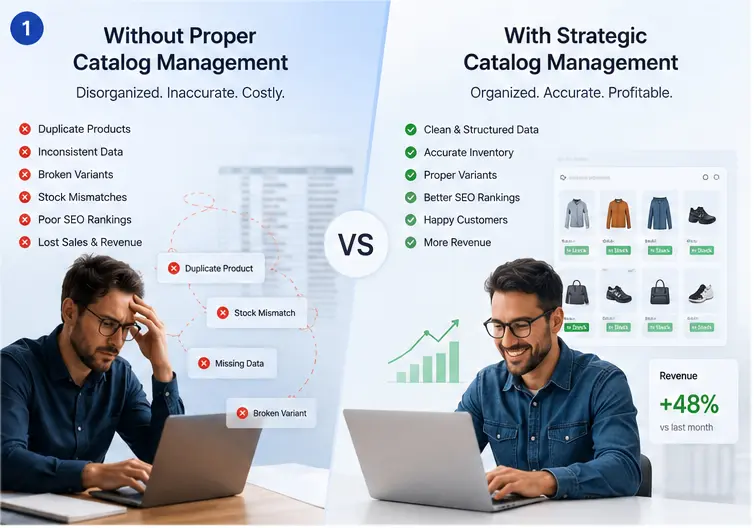
1. What E-Commerce Catalog Management Actually Involves
E-commerce catalog management is the ongoing technical process of organizing, structuring, and maintaining product data across a digital storefront. That data includes SKUs, pricing tiers, product attributes, variant relationships, descriptions, media assets, and metadata — all of which need to be accurate, consistent, and formatted correctly for both the platform and the search engines indexing your store.
At a small scale, this is manageable with basic spreadsheet work and manual uploads. At a large scale, manual processes break down in specific and predictable ways.
A product is never just a title, a price, and an image. In a high-volume environment, a single product can carry 30 to 50 distinct data points: material attributes, size and color variants linked to a parent SKU, weight and dimension data for shipping calculations, category assignments, custom metafields for faceted search filters, alt text for images, and structured data markup for Google Rich Results. Every one of those data points needs to be accurate and consistently formatted across thousands of records.
When they are not, the consequences show up across the business. Customers filter by size and get incorrect results. Google indexes product pages with empty metafields and ranks them poorly. A seasonal launch gets delayed by two weeks because the data import keeps failing at the 3,000-row mark.
Proper e-commerce catalog management prevents all of this by treating your product database as infrastructure — something that requires architecture, governance, and ongoing maintenance, not just occasional manual updates.
2. The Scaling Bottleneck: When Manual Data Entry Breaks Down
Many growing brands treat product uploading as an administrative task and assign it to generalist staff without a defined data standard. This approach works at 100 products. It breaks badly at 1,000, and it becomes completely unworkable at 10,000.
Here is what unmanaged e-commerce catalog management looks like at scale:
Inconsistent taxonomies. Products land in incorrect or overlapping categories because there is no enforced taxonomy standard. Customers browsing by category get irrelevant results. Faceted search filters return confusing output. The store feels disorganized even when the design is clean.
Broken parent and child variant relationships. Size and color variants become detached from their parent products during bulk imports. Customers see the same product listed five times as separate items rather than as a single listing with variant options. This creates duplicate content issues that hurt SEO and confuse the shopping experience.
SEO degradation from missing metadata. Empty alt text fields, blank meta descriptions, and unformatted product titles mean your product pages compete for organic traffic with one hand tied behind their back. At scale, hundreds or thousands of product pages with incomplete SEO data represent a significant traffic loss that compounds over time.
Time-to-market delays. When a new product line needs to go live for a seasonal campaign and the upload process takes three weeks because of data formatting problems and failed imports, that delay has a direct revenue cost. E-commerce catalog management done correctly makes product launches predictable.
3. Data Structuring and Taxonomy Engineering
The foundation of effective e-commerce catalog management is a logical, scalable data architecture. Before any products get uploaded, the taxonomy needs to be defined — category hierarchies, attribute sets, custom metafield structures, and tag conventions that will hold up as the catalog grows.
We map out the full product data model for your store before any migration or bulk upload work begins. This means defining:
- Top-level categories and subcategory hierarchies that match how your customers browse
- Attribute groups standardized across product types — so “Color” always maps to the same field and always uses the same value format
- Parent and child SKU relationships configured correctly so variant products display as a single listing with selectable options
- Custom metafields for data points your platform does not capture by default — technical specifications, compatibility information, or custom filtering attributes
- Tag conventions that power your store search and automated collection rules
This architecture work is what separates e-commerce catalog management that scales from catalog management that creates more problems as the product count grows. A well-designed taxonomy makes every future product addition faster and every future data migration cleaner.

4. Bulk Product Uploads at Scale
Uploading 5,000 or 10,000 products is not the same process as uploading 50. Standard CSV imports through a platform interface regularly fail at high volumes due to server timeouts, API rate limits, and data formatting inconsistencies that only surface when the file reaches a certain size.
Our e-commerce catalog management approach to bulk uploads uses programmatic import solutions built around the specific constraints of your platform. For Shopify, that means working within the Admin API and GraphQL bulk operations endpoint with proper rate limit handling. For WooCommerce, it means direct database imports with server-side validation rather than relying on the standard REST API for large-volume work.
Before any data touches your live server, we run it through a scrubbing process:
- Duplicate SKU detection and resolution
- Variant relationship verification across parent and child records
- Image asset bulk optimization for Core Web Vitals compliance before upload
- Metafield validation against your defined data architecture
- Category and tag assignment verification against your taxonomy standard
The result is a clean, error-free import that goes live without the broken listings, missing images, and detached variants that typically show up after a high-volume manual upload.
5. Multi-Channel Inventory Syncing
Selling across multiple channels — your own Shopify or WooCommerce store, Amazon, eBay, a wholesale portal, and potentially a physical retail location — creates an inventory management problem that e-commerce catalog management must address at the architecture level.
Without real-time synchronization, every channel maintains its own inventory count independently. A sale on Amazon does not automatically reduce stock on your Shopify store. Overselling becomes a constant risk. Fulfillment errors follow. Customer complaints and refunds accumulate.
We architect and maintain the API connections between your central inventory source — whether that is an ERP system, a dedicated inventory management platform, or your primary storefront — and every active sales channel. When a product sells on any channel, inventory counts update across all connected platforms in real time.
This synchronization layer is a core component of e-commerce catalog management at scale. It protects your customer experience, reduces fulfillment errors, and gives your operations team accurate stock data to make purchasing and merchandising decisions.
6. The SEO Impact of Clean Product Data
E-commerce catalog management is not just an operational discipline. It is also one of the most effective SEO strategies available to high-volume stores — and one of the most consistently underutilized.
When product data is structured cleanly in the backend, implementing dynamic structured data markup becomes straightforward. Properly formatted schema markup based on guidelines from Schema.org allows Google to display Rich Snippets in search results — showing your product star ratings, live pricing, and stock availability before a user even clicks your link. Rich Snippets consistently improve organic click-through rates.
Beyond structured data, clean e-commerce catalog management directly improves your on-page SEO at scale:
- Unique, formatted product titles that include target search terms rather than manufacturer codes
- Meta descriptions populated from structured product data rather than left blank
- Alt text on every product image, generated from standardized attribute data
- Canonical tags on variant pages that consolidate ranking signals to the primary product listing
- Internal linking between related products and categories that distributes page authority across the catalog
For a store with 10,000 product pages, the aggregate SEO impact of fixing these elements across the full catalog is substantial. It is the kind of organic traffic improvement that paid advertising cannot replicate.
7. Frequently Asked Questions About E-Commerce Catalog Management
Q1: How long does it take to upload and structure a large product catalog?
The timeline depends on catalog size and the quality of your existing data. A catalog of 1,000 well-formatted SKUs with clean source data typically takes 5 to 10 business days including taxonomy setup, data scrubbing, and import verification. Catalogs of 5,000 to 10,000 SKUs with complex variant structures are scoped individually after a technical data audit. We provide a specific timeline estimate before any work begins.
Q2: Can you migrate our product catalog from one platform to another?
Yes. We handle complete e-commerce catalog management migrations between platforms — including Shopify to WooCommerce, WooCommerce to Shopify, Magento to Shopify, and custom platform exports to any major destination. Migrations include full data integrity verification and SEO equity preservation through proper 301 redirect mapping so your product page rankings transfer to the new URLs.
Q3: Do you write product descriptions, or just handle the data upload?
Both. Our e-commerce catalog management service includes technical data structuring and upload execution for your existing inventory. For your highest-margin or highest-traffic product lines, we also provide SEO-optimized product description copywriting that avoids duplicate content penalties and targets the specific search terms your customers use.
Q4: How do you handle products with many variants?
Variant management is a core part of our e-commerce catalog management process. We configure parent and child SKU relationships correctly at the data architecture level before any upload begins — mapping size, color, material, and any other attribute combinations to their parent listing with the correct pricing, inventory, and image assignments. This prevents the detached variant and duplicate listing problems that commonly appear after manual bulk uploads.
Q5: Can you set up automated product feeds for Google Shopping and Meta?
Yes. Product feed management is an extension of e-commerce catalog management. We structure your catalog data to meet Google Merchant Center and Meta Commerce Manager feed specifications, configure automated feed generation and submission, and monitor feed health to catch attribute errors or disapproved products before they affect your paid campaigns.
Q6: What platforms do you support for catalog management?
We work primarily with Shopify and WooCommerce for our e-commerce catalog management service, including Shopify Plus for enterprise-tier stores. We also support BigCommerce, Magento 2, and headless commerce architectures where product data is managed through a PIM or custom backend and pushed to the frontend via API.
Clean Data. Faster Launches. Better Rankings.
At a certain scale, the quality of your product data determines the quality of your customer experience, your search visibility, and your operational efficiency. Chaotic catalog data does not just slow your team down — it actively limits what your storefront can do and what your customers can find.
Our e-commerce catalog management service brings the technical architecture and execution capacity to build a product database that scales with your business instead of fighting it. Clean taxonomy, accurate variant relationships, optimized media assets, structured data markup, and real-time inventory synchronization — all managed by engineers who understand the full stack your storefront runs on.
MarkupMarvel has managed product catalogs for high-volume Shopify and WooCommerce stores across fashion, consumer electronics, wholesale, and specialty retail. We know where catalog data breaks down at scale, and we know how to build the systems that prevent it.
Explore
Other Services We Provide

7 Smart Custom LMS Development Services That Scale
Coaches, universities, corporate training teams, and ed-tech founders are using digital learning to reach global...
Service Details →
7 Expert MERN Stack Development Services for Fast SaaS
A WordPress site or a basic PHP backend can get a product to market. What...
Service Details →
GEO and AEO Services: 7 Proven Ways to Win AI Search
The shift is not subtle. Users who previously typed a search query, scrolled through ten...
Service Details →