
7 Best Custom Laravel Development Services That Scale
Advanced Laravel Engineering: Architecting Secure Enterprise Backends In the world of enterprise software, the frontend user interface is the beautiful paint job on a high-performance vehicle. It is what your customers see, touch, and fall in love with. However, a stunning frontend design is completely useless if the invisible engine underneath—the backend architecture—cannot securely and rapidly process the complex business logic required to keep the vehicle moving. As B2B platforms, SaaS applications, and internal enterprise portals begin to scale, they are inevitably forced to handle highly complex relational data, incredibly strict user permission roles, and heavy, concurrent API requests from third-party software. When a backend is poorly engineered or duct-taped together using the wrong framework, it results in agonizingly slow database query times, dangerous data privacy leaks, and a messy codebase that is mathematically impossible to maintain or scale.
[toc]
7 Best Custom Laravel Development Services That Scale
Every software product has two sides. The frontend is what your users see — the interface they click through, the dashboard they log into, the forms they fill out. The backend is everything else: the logic that processes their data, enforces their permissions, talks to third-party systems, and keeps the whole thing running under load.
Most early-stage products get the frontend right. The backend is where things quietly fall apart.
A poorly architected backend does not announce itself immediately. It shows up later — in query times that creep up as the database grows, in permission logic that breaks when you add a new user role, in a codebase that no one on the team wants to touch because changing one thing reliably breaks something else. By the time the problems are obvious, fixing them is expensive.
Laravel is the framework that prevents this. Built on PHP’s MVC pattern, it provides the structure, the security tooling, and the database abstraction layer that complex business applications need — without forcing engineers to rebuild foundational infrastructure from scratch on every project.
At MarkupMarvel, our custom Laravel development services are used to build backends that hold up: SaaS platforms, B2B portals, internal enterprise tools, REST APIs, and legacy modernization projects where the stakes of getting it wrong are real.
1. What Laravel Is and Why Enterprise Teams Use It
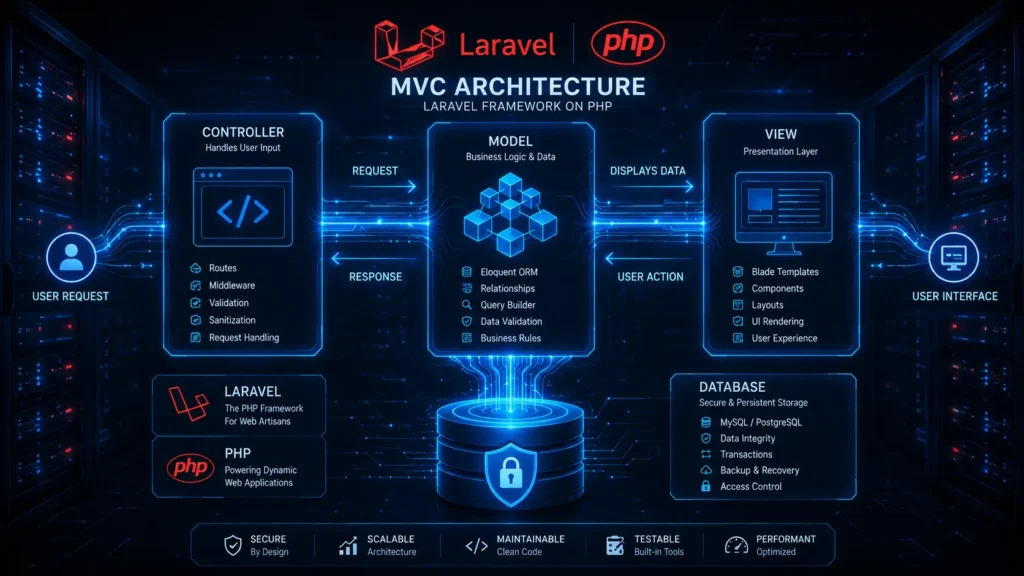
Laravel is an open-source PHP framework built around the MVC (Model-View-Controller) architectural pattern. It was designed for developers building applications with complex logic, relational data, and strict security requirements — not for simple content sites.
What separates Laravel from lightweight PHP setups is what it provides out of the box. Eloquent ORM for database interaction. A routing system that keeps API structure clean. Built-in CSRF protection and session security. A queue system for background jobs. An authentication scaffolding that handles the security fundamentals correctly by default.
For a backend engineer, this means less time writing boilerplate infrastructure and more time writing the business logic that is actually specific to your product. For a business, it means a faster build, a more consistent codebase, and a backend that does not require major rearchitecting every time requirements change.
Laravel has been consistently ranked among the most popular PHP frameworks in use globally, with a large, active developer community and a well-maintained ecosystem of first-party packages. When you build on Laravel, you are building on a foundation that is actively developed, well-documented, and widely understood — which matters when your team grows or when you need to bring in outside engineers.
According to the JetBrains Developer Ecosystem Survey, Laravel is the most widely used PHP framework among professional developers worldwide — a reflection of how broadly it has been adopted for production-grade applications.
2. What Happens When the Wrong Backend Architecture Is Used
One of the most common and expensive patterns we see is companies trying to build complex software on a foundation that was never designed for it. WordPress is the most frequent example — a platform built for content publishing, stretched into serving as an application backend for a CRM, a multi-vendor marketplace, or an internal operations portal.
The problems are predictable, but they rarely surface immediately. They compound over time.
Disorganized code that becomes impossible to maintain
Without the structural discipline of an MVC framework, backend code tends to sprawl. Business logic ends up scattered across files, mixed in with presentation code, duplicated in multiple places. A developer makes a change to one part of the system and breaks something in a completely unrelated area. Over time, the codebase reaches a state where nobody is confident making changes without extensive testing — and the testing itself takes longer because the logic is hard to isolate.
This is what engineers refer to as technical debt. It does not prevent the product from working today, but it slows down every change you make tomorrow, and the cost compounds as the codebase grows.
Security gaps that emerge under scrutiny
Handling sensitive business data — financial records, customer PII, proprietary operational data — requires deliberate, consistent security practices. SQL injection prevention, CSRF protection, proper password hashing, session management, input sanitization — these need to be built into the architecture, not handled inconsistently across different parts of the codebase.
Lightweight setups and plugin-heavy CMS installations frequently fail basic security audits. The vulnerabilities are not always obvious until a penetration test or, worse, an actual breach makes them visible.
Database performance that degrades as data grows
Queries that run in milliseconds at 10,000 rows become slow at 1,000,000 rows if the database was not designed with scale in mind. Missing indexes, unoptimized joins, the N+1 query problem — these are backend issues that do not show up in development but create serious problems in production. The result is server timeouts, 502 errors, and degraded performance exactly when traffic is highest.
Custom Laravel development services address all three of these problems at the architecture level.
3. MVC Architecture and Clean Codebase Standards
The Model-View-Controller pattern is the organizational foundation of every Laravel application we build. It is not just a convention — it is the structural decision that determines how maintainable the codebase will be six months and two years from now.
In practice, MVC means your business logic lives in one place, your database interactions live in another, and your presentation layer is separate from both. When a change needs to be made — a new pricing rule, a modified permission check, an updated data validation requirement — it happens in the correct layer without touching the others.
For development teams, this means bugs are easier to isolate and fixes are less likely to create unintended side effects. For business stakeholders, it means new features can be added without risking the stability of existing ones.
We follow Laravel’s conventions strictly and extend them where the application requires it. Controllers stay thin — they handle routing logic and delegate to service classes. Business logic lives in service and action classes, not in models or controllers. Database interactions go through Eloquent with explicit query scoping. The result is a codebase that a new engineer can navigate without a lengthy orientation.
4. Eloquent ORM and Database Performance Optimization
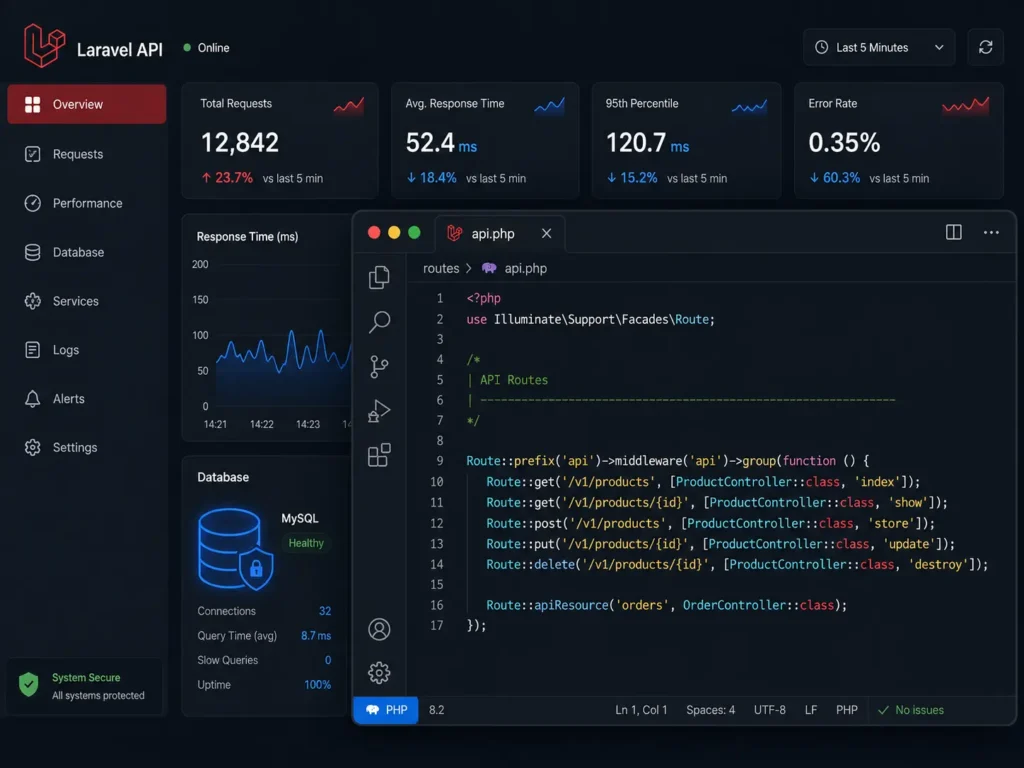
Laravel’s Eloquent ORM is one of the framework’s most powerful features — and one of the most frequently misused. Writing Eloquent queries that work is straightforward. Writing Eloquent queries that perform well at scale requires deliberate engineering.
The most common performance problem in Laravel applications is the N+1 query problem. It happens when an application loads a collection of records and then issues a separate database query for each one to fetch related data. At small data volumes, it is invisible. At production scale, it causes query counts to multiply with record counts, and response times degrade accordingly.
We identify and eliminate N+1 problems during development using Laravel Debugbar and query analysis — not after they surface in production monitoring. Eager loading relationships, query scoping, and result caching are standard practices in our builds, not optimizations added later.
For applications with complex reporting requirements or heavy read workloads, we implement caching layers using Redis or Memcached. Frequently accessed data that does not change on every request — configuration data, aggregated metrics, permission matrices — is cached and served from memory rather than queried from the database on each request. The performance difference is significant at scale.
Database indexing is addressed during the schema design phase. The indexes that a production database needs are determined by the queries the application will run, and those queries are known during development. We design schemas with production query patterns in mind, not as an afterthought
5. Authentication, Authorization, and Enterprise Security
Security in a Laravel application is not a single feature — it is a set of practices that need to be applied consistently across the entire codebase. A single unprotected endpoint, a single missing authorization check, a single improperly handled user input is enough to create a vulnerability.
We build security into the architecture from the start.
Authentication is handled using Laravel Sanctum for SPA and mobile API authentication, or Laravel Passport for OAuth2 flows requiring third-party integrations. Token expiry, refresh token rotation, and secure cookie handling are configured correctly by default — not left at framework defaults that may not match your security requirements.
Authorization uses Laravel’s Gate and Policy system to implement Role-Based Access Control at the application layer. Every sensitive action — reading a record, updating a resource, accessing an admin function — has an explicit authorization check. Users with insufficient permissions receive a proper rejection response, not just a hidden UI element that a determined user could bypass.
Input validation and sanitization happens at the request layer before data reaches the controller or the database. Laravel’s Form Request classes centralize validation logic and keep controllers clean. SQL injection through Eloquent is handled at the ORM level, but we also validate and sanitize user input defensively regardless of what the ORM provides.
CSRF protection is enabled by default in Laravel and applied to all state-changing requests. We verify this is correctly configured and not inadvertently disabled for API routes that should require it.
For enterprise applications handling PII or financial data, we also implement audit logging — a record of which user performed which action, when, and on what data. This is a compliance requirement in many industries and a useful operational tool in all of them.
6. Legacy PHP Modernization
A significant portion of our custom Laravel development services work involves existing systems rather than greenfield builds. Many businesses are running on PHP codebases that were written years ago — sometimes by developers who are no longer available, sometimes in frameworks that are no longer maintained, sometimes in plain PHP with no framework at all.
These systems accumulate risk over time. Deprecated PHP versions stop receiving security patches. Libraries go unmaintained. The code itself becomes harder to understand and modify as the original context fades. Every change carries more risk than it should.
Modernizing a legacy PHP system is a careful process. We start with a thorough audit — understanding what the system does, what data it holds, where the security exposures are, and what the migration path looks like. We document the business logic that needs to be preserved before touching any code.
The migration itself happens in stages. We do not take the system offline and rebuild it from scratch — that approach creates the risk of missing edge cases that only show up in production. Instead, we migrate functionality incrementally, running the old and new systems in parallel where necessary, validating outputs at each step before moving forward.
The result is a modern Laravel codebase that does what the legacy system did, without the security debt, the maintenance burden, and the deployment anxiety that comes with running deprecated software in production.
7. REST API Development and Third-Party Integrations
Modern software does not operate in isolation. Your backend needs to communicate with the services your business runs on — payment processors, CRM platforms, logistics providers, mobile applications, third-party data sources. The quality of those integrations directly affects how reliably your system operates.
We build REST APIs using Laravel’s routing and controller structure, with consistent response formatting, proper HTTP status codes, and API versioning built in from the start. Every endpoint is documented, and every integration is tested against the actual external service — not just mocked in unit tests.
For authentication on API endpoints, we use Laravel Sanctum for token-based authentication or Passport for OAuth2 flows. Rate limiting, request throttling, and API key management are configured to protect the backend from abuse.
Common integrations we build and maintain: Stripe for subscription billing and payment processing, SendGrid and Mailgun for transactional email, Twilio for SMS, Salesforce and HubSpot for CRM sync, and custom webhook systems for event-driven architectures. For enterprise systems with specific integration requirements — proprietary ERPs, internal data warehouses, industry-specific platforms — we build custom API bridges designed around the external system’s actual behavior, not just its documentation.
According to Laravel’s official documentation, the framework’s API resource and versioning tools are specifically designed for building maintainable, production-grade APIs that can evolve without breaking existing integrations — a consideration that becomes increasingly important as your integration surface grows.
Frequently Asked Questions
Q: Why choose custom Laravel development services over Node.js or Python?
Laravel provides a mature, structured approach to relational data, complex business logic, and traditional enterprise workflows. Node.js is better suited to highly concurrent real-time applications. Python has advantages in machine learning contexts. For data-driven SaaS platforms, CRMs, and B2B portals built on relational databases with complex permission models, Laravel’s Eloquent ORM, built-in security tooling, and queue system make it a strong fit.
Q: Can Laravel be used as an API backend for a React or Next.js frontend?
Yes — this is a common architecture we use. Laravel handles all backend logic, authentication, and data management as a headless API. A React or Next.js frontend consumes those APIs and handles the user interface. The two layers are developed and deployed independently, which gives each one the right tool for its job.
Q: Is Laravel capable of scaling to handle high-traffic SaaS applications?
Yes, when architected correctly. Horizontal scaling with load-balanced cloud infrastructure, queue workers for background processing, caching layers for frequently accessed data, and database read replicas for heavy read workloads — Laravel supports all of these. Laravel Vapor also provides serverless deployment on AWS for applications that need to scale automatically without managing server infrastructure.
Q: Can you modernize our existing legacy PHP application?
Yes. Legacy modernization is a core part of our custom Laravel development services. We audit the existing system, document the business logic, and migrate incrementally to a modern Laravel environment. Data integrity and operational continuity are the primary constraints we design around.
Q: Do you write automated tests for the backend?
Yes. We write PHPUnit unit tests for business logic and Laravel’s built-in feature tests for API endpoints and application flows. Automated testing is part of the development process, not a separate phase at the end — which means regressions are caught during development rather than in production.
Q: What does ongoing support look like after launch?
We provide managed maintenance, security patching, performance monitoring, and priority support for production applications. For SaaS platforms, we also conduct periodic code reviews and database performance audits as the application grows and usage patterns change.
Build a Backend That Holds Up
A backend that works today but cannot handle tomorrow’s requirements is not an asset — it is a delayed problem. The cost of rearchitecting a production system under pressure is always higher than the cost of building it correctly the first time.
Custom Laravel development services give you a backend with real structure: clean separation of concerns, proper security practices, a database layer designed for the queries you will actually run, and a codebase that a development team can maintain and extend without accumulating debt.
MarkupMarvel engineers Laravel backends for businesses that take their software seriously.
Explore
Other Services We Provide

UI UX Design to Code: 7 Proven Services That Convert
A stunning UI/UX design is only as impactful as the code that brings it to...
Service Details →
7 Proven Custom Shopify Development Services That Convert
There is a moment every growing e-commerce brand hits. The store is live, sales are...
Service Details →
GEO and AEO Services: 7 Proven Ways to Win AI Search
The shift is not subtle. Users who previously typed a search query, scrolled through ten...
Service Details →