
Custom AI Integration Services: 7 Proven Ways That Work
In the modern business landscape, Artificial Intelligence is no longer an experimental luxury or a futuristic buzzword; it is a foundational requirement for any competitive enterprise. However, there is a massive disconnect in how businesses are attempting to adopt it. While generic, consumer-facing AI tools (like the public version of ChatGPT) are fantastic for individual employee productivity, they do not inherently understand your business. They do not have access to your proprietary databases, your historical customer interactions, or your secure financial records.
[toc]
Custom AI Integration Services: 7 Proven Ways That Work
Most businesses are using AI the wrong way.
They sign up for a public ChatGPT subscription, give their team access, and call it an AI strategy. The team uses it for drafting emails and summarizing documents, which is genuinely useful — but it has nothing to do with the operational problems that are actually costing the business time and money.
Public AI tools do not know your business. They have never seen your product catalog, your customer history, your internal documentation, or your operational workflows. Every time an employee uses a consumer AI tool for business tasks, they are working around the gap between generic AI and the specific context your business runs on.
Custom AI integration services close that gap. Rather than giving your team a generic tool that approximates answers, we embed AI directly into your existing software — connected to your actual data, trained on your specific context, and authorized to take real actions inside your systems.
At MarkupMarvel, we build custom AI integration services for B2B platforms, SaaS products, and enterprise operations teams. Not chatbot widgets. Not prompt engineering workshops. Actual software engineering that makes your platform significantly more capable than it was before.
1. Consumer AI vs. Enterprise AI: Why the Distinction Matters
The difference between a consumer AI tool and a properly engineered custom AI integration is not a matter of degree — it is a matter of architecture.
Consumer tools like the public version of ChatGPT are trained on publicly available internet data. They are designed for general-purpose use across millions of different users and use cases. They are good at many things, but they do not know anything specific about your business, your customers, or your data. Every interaction starts from zero context.
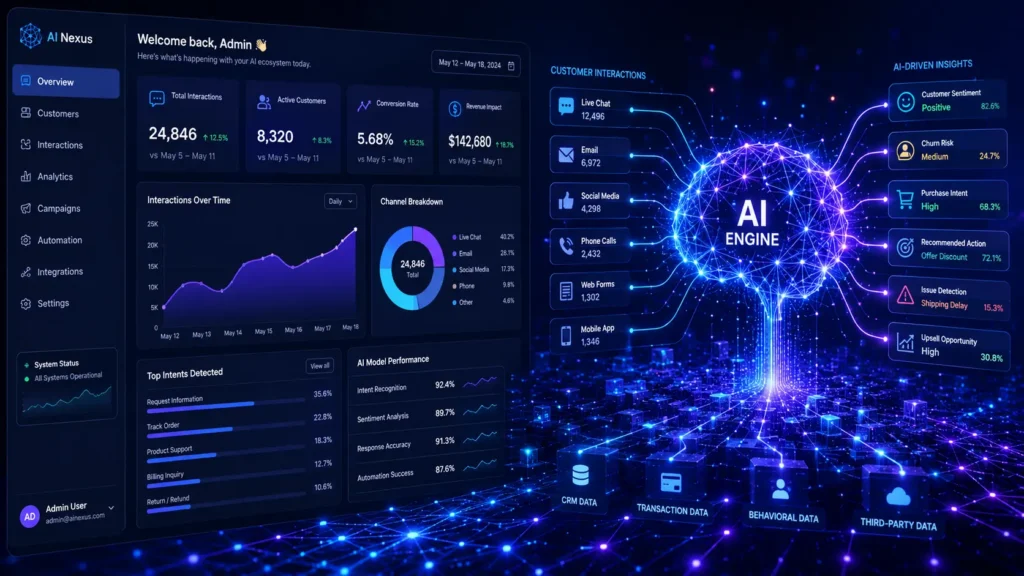
Enterprise AI integration is architecturally different. We connect AI models directly to your private data — your internal documentation, your customer records, your product database, your support history. When your platform’s AI responds to a query, it is not generating a plausible-sounding answer based on generic training data. It is retrieving the actual relevant information from your systems and constructing a response grounded in verified, current data.
The technical framework that makes this possible is called RAG — Retrieval-Augmented Generation. Instead of relying on what the model already knows, RAG retrieves the specific documents or records relevant to the query from your private knowledge base, then uses the AI to synthesize a response from that retrieved content. The result is accurate, context-specific, and traceable back to real source material.
This is the architectural foundation of every custom AI integration service we build. The model’s intelligence, applied to your data.
According to OpenAI’s enterprise documentation, enterprise API usage comes with zero-data-retention agreements — meaning your data is processed to generate your output and is not retained or used for model training. This is a critical distinction from consumer-tier access.
2. Where Manual Cognitive Work Is Costing You the Most
Before building anything, we identify where the highest-value automation opportunities exist in your operation. The answer is almost always in the same three places.
Customer support at scale
A scaling business with a growing customer base faces a choice: hire more support staff to maintain response times, or let response times degrade. Both options are expensive in different ways. Hiring is a recurring cost that scales linearly with customer volume. Slow response times cost you customers and damage retention.
Custom AI integration services create a third option. An AI agent connected to your product documentation, your order management system, and your customer history can handle the majority of tier-1 support queries — order status, returns, product questions, account issues — without human involvement. Response time drops to seconds. The queries that genuinely require human judgment are escalated with full context already assembled.
Unstructured data that nobody has time to process
Every business accumulates data it cannot easily use. PDFs from vendors. Email threads with buried action items. Support tickets with unextracted issue patterns. Sales call recordings that nobody has time to review. This data has real value, but extracting it manually is expensive and slow.
AI can process this kind of unstructured data at scale. Vendor invoices become structured JSON. Support ticket patterns become product insights. Sales call recordings become objection analysis. The data your business generates becomes usable without adding headcount to process it.
Content at volume
For e-commerce businesses managing large product catalogs, writing unique, accurate, SEO-optimized product descriptions for every SKU is a production bottleneck. For content-heavy platforms, generating first drafts, summaries, and localized variations requires more writing capacity than most teams have.
AI connected to your product data and brand guidelines can generate this content at volume — not as a replacement for editorial judgment, but as a way to get to a reviewable draft in minutes rather than hours.
3. Custom LLM Architecture and Private Knowledge Base Setup
The technical foundation of our custom AI integration services is the connection between the AI model and your private data.
We use LangChain and LlamaIndex to build the retrieval pipelines that connect AI models to your knowledge base. These frameworks handle the complexity of breaking your documents into retrievable chunks, embedding them into vector representations, storing them in a vector database, and building the retrieval logic that finds the most relevant content for any given query.
Vector databases — we use Pinecone, Weaviate, or Qdrant depending on scale and infrastructure requirements — store your content in a format that enables semantic search. This means the retrieval is not keyword matching. It is meaning-based. A query about “cancellation policy” retrieves the relevant content even if the source document uses the phrase “subscription termination terms.”
The AI model — GPT-4, Claude, Gemini, or an open-source alternative — receives the retrieved content as context and generates a response grounded in that material. We configure the system prompt to constrain the model to your approved sources, enforce your brand voice, and define how it should handle queries that fall outside its knowledge base.
The practical result: your platform has a knowledge layer that knows everything in your documentation, answers accurately, stays on brand, and does not generate responses from outside your approved content.
4. Intelligent Automation Agents That Take Real Action
There is a significant difference between an AI that answers questions and an AI that does things.
A basic chatbot answers questions. It looks up information, generates a response, and waits for the next input. This is useful, but it is the lower end of what custom AI integration services can deliver.
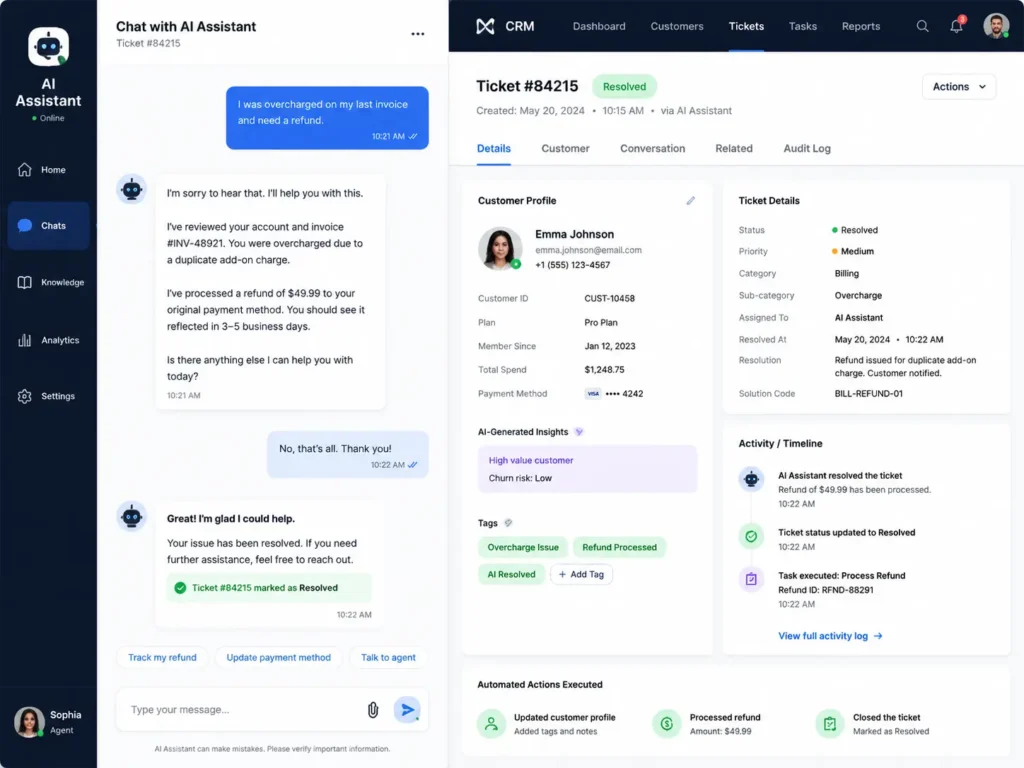
An autonomous agent can take actions. It can query your database to check real-time inventory. It can process a refund through your payment API. It can update a record in your CRM. It can draft and stage an email for human approval. It can trigger a workflow in your project management system based on the outcome of a conversation.
We build agents using frameworks that support tool use — the ability for the AI to call external APIs and internal functions as part of completing a task. The agent receives a user request, determines what actions are needed to fulfill it, executes those actions in the correct sequence, handles errors and edge cases, and returns a result.
A customer service agent built this way does not just tell a user their order is delayed. It checks the current status, identifies the reason for the delay, applies any applicable compensation policy, drafts a response explaining the situation, and flags the case for human review if the situation falls outside standard parameters — all in a single interaction.
This is the difference between automation that answers and automation that resolves.
5. Automated Data Processing and Predictive Analytics
Beyond customer-facing applications, custom AI integration services unlock significant value inside your data operations.
Document processing and data extraction
Businesses that receive high volumes of documents — vendor invoices, contracts, insurance claims, application forms — spend enormous amounts of staff time extracting structured data from unstructured inputs. AI can handle this at scale with high accuracy.
We integrate document processing pipelines that take incoming PDFs or images, run them through OCR and AI extraction, and output structured data in the format your systems require. A vendor invoice becomes a structured JSON object with line items, amounts, dates, and vendor details — automatically, without manual data entry.
Behavioral pattern analysis and churn prediction
For SaaS platforms, the signals that predict customer churn are often visible in usage data weeks before a customer cancels. Login frequency, feature engagement, support ticket volume, billing page visits — these behavioral patterns carry predictive signal that most platforms are not using.
We integrate machine learning models into your analytics pipeline that score users on churn probability based on their behavioral patterns. Your customer success team gets a prioritized list of at-risk accounts before those accounts have decided to leave, giving them time to intervene.
Dynamic content personalization
For platforms with large user bases, delivering the same content and recommendations to every user is a significant missed opportunity. AI-driven personalization — product recommendations, content suggestions, search ranking — responds to individual user behavior rather than aggregate patterns.
We integrate personalization layers into your existing platform that improve with usage. The more a user interacts with your platform, the more accurately the system can anticipate what they need next.
6. Enterprise Security and Private AI Deployment
Data security is the question every enterprise stakeholder asks first when AI integration comes up, and it deserves a direct answer.
When we use commercial AI APIs — OpenAI, Anthropic, Google — we route all requests through enterprise API endpoints. These come with contractual zero-data-retention agreements: your data is used to generate your output and is not stored, logged for training purposes, or accessible to anyone other than your application. This is architecturally different from consumer-tier access, where data handling terms are significantly less protective.
All data in transit between your platform and the AI API is encrypted. All data stored in your vector database is encrypted at rest. Access to the AI layer is controlled through your existing authentication and authorization infrastructure.
For organizations in regulated industries — healthcare, legal, financial services, defense — where third-party data processing is not acceptable regardless of contractual protections, we offer fully self-hosted deployments.
We deploy open-source models — Meta’s LLaMA 3, Mistral, or Falcon — on your private AWS or Google Cloud infrastructure. The model runs inside your security perimeter. Your data never leaves your controlled environment. You get the capabilities of a modern large language model with the data sovereignty of a fully internal system.
According to AWS’s security documentation, deploying AI workloads within a private VPC with proper IAM controls and encryption at rest and in transit meets the security requirements of most regulated industries — a configuration we implement as standard for enterprise deployments.
7. Integration with Legacy Systems and Existing Platforms
Custom AI integration services do not require rebuilding your existing platform. In most cases, we integrate the AI layer into what you already have.
For platforms with accessible REST APIs or database connections, we build middleware that sits between your existing system and the AI layer. Your platform sends queries or data to the middleware. The middleware retrieves relevant context from the vector database, constructs the prompt, calls the AI API, and returns the result to your platform in the format it expects. From your platform’s perspective, it is calling an internal API endpoint — the AI complexity is abstracted behind a clean interface.
For legacy systems without modern API layers, we work with the data access methods available — direct database connections, file exports, webhook endpoints — to build integration pipelines that do not require changes to the underlying system.
The practical implication: your existing platform does not need to be rebuilt to get AI capabilities. The AI layer is added on top of what is already working.
Frequently Asked Questions
Q: Are custom AI integration services secure enough for sensitive enterprise data?
Yes, when built correctly. We use enterprise API endpoints with zero-data-retention agreements for commercial models, encrypt all data in transit and at rest, and implement access controls that limit what data the AI layer can access. For organizations requiring complete data sovereignty, we deploy open-source models on private infrastructure where no data leaves your environment.
Q: How do you prevent the AI from generating inaccurate or hallucinated responses?
We use RAG architecture to ground the AI’s responses in your verified data sources. The model is constrained by system prompt to generate responses only from retrieved content. When the knowledge base does not contain relevant information, the system is configured to acknowledge the gap and route to a human agent rather than generating a plausible but unverified answer.
Q: Can you integrate AI into our older legacy software?
Yes. As long as your legacy system has a database we can connect to or an API we can call, we can build a middleware layer that brings AI capabilities to your existing platform without requiring a full rebuild.
Q: How long does a custom AI integration project take?
A focused integration — an RAG-powered support agent trained on your documentation, for example — typically takes 4 to 8 weeks from scoping to deployment. Larger, multi-system automation pipelines take longer depending on the complexity of the data sources and the number of systems involved.
Q: What does the ROI look like for custom AI integration services?
The most immediate returns come from support automation — reducing the volume of queries that require human handling and shortening response times. Secondary returns come from data processing automation — eliminating manual data entry and document processing tasks. Most clients see meaningful reductions in operational overhead within the first quarter after deployment.
Q: Which AI models do you work with?
We work with OpenAI’s GPT-4 and GPT-4o, Anthropic’s Claude, Google’s Gemini, and open-source models including Meta’s LLaMA 3 and Mistral. Model selection depends on your use case, performance requirements, cost constraints, and data privacy requirements.
Your Platform Deserves a Brain That Knows Your Business
Generic AI tools are useful for individual productivity. They are not a substitute for AI that understands your specific data, follows your specific business rules, and is authorized to take real actions inside your systems.
Custom AI integration services are how you move from AI as a productivity accessory to AI as a core part of how your platform operates. The businesses building this capability now are creating operational advantages that will compound over time.
MarkupMarvel builds custom AI integration services for platforms that are ready to operate at a higher level.
Explore
Other Services We Provide

7 Reasons to Choose Custom WordPress Development
WordPress runs more than 40% of the entire internet. That single statistic gets repeated everywhere...
Service Details →
Custom Booking Reservation Systems: 7 Powerful Features
A double booking that results in two customers showing up for the same slot. A...
Service Details →
Proven Managed Web Hosting Services We Offer: 7 Solutions
You just invested tens of thousands of dollars engineering a custom, high-performance web application. Do...
Service Details →