7 Smart Custom LMS Development Services That Scale
Coaches, universities, corporate training teams, and ed-tech founders are using digital learning to reach global audiences, train employees faster, and build consistent recurring revenue streams. But the moment a growing e-learning operation starts to scale, the hard ceiling of off-the-shelf course platforms becomes impossible to work around.
[toc]
Custom LMS Development Services for Serious E-Learning Businesses
Online education is no longer a side project for digital creators. For a lot of businesses right now, it is the main product.
Coaches, universities, corporate training teams, and ed-tech founders are using digital learning to reach global audiences, train employees faster, and build consistent recurring revenue streams. But the moment a growing e-learning operation starts to scale, the hard ceiling of off-the-shelf course platforms becomes impossible to work around.
Early on, tools like Teachable, Thinkific, Kajabi, or a basic WordPress LMS plugin feel like enough. You upload videos, connect Stripe, and launch within days. That works fine for a single-tier course with a few hundred students.
Then your audience grows. And things get complicated.
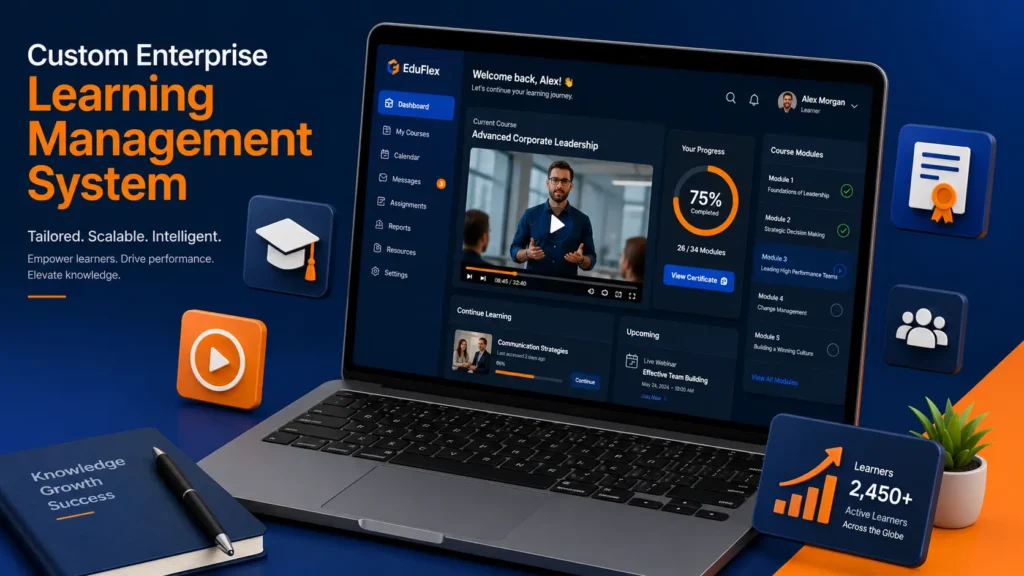
You start needing custom student dashboards, company-level reporting, prerequisite quizzes, private communities, multi-tenant corporate portals, and real video protection. You need a learning environment that looks and operates like your own platform — not a white-labeled version of someone else’s SaaS product.
That is where custom LMS development services come in. At MarkupMarvel, we build Learning Management Systems for businesses that need actual control over their content, their student data, and their revenue logic. We do not drop in a theme and call it a platform. We design and build the entire learning infrastructure around your specific content model, your sales flow, and the long-term direction of your business.
1. Why Generic Course Platforms Eventually Work Against You
Hosted course platforms are a reasonable starting point when you are testing an idea. The problem shows up later — when your business has outgrown the structure they put you in.
Most of these platforms give you almost no control over the checkout flow, the student dashboard layout, user roles, or backend reporting. You can change your logo and pick a color scheme. But the underlying experience still belongs to their product, not yours.
That matters more than people realize. If students are paying several hundred dollars — or more — for a professional certification or a corporate compliance program, a generic template sends the wrong signal. It looks like you rented space on someone else’s platform. Because you did.
Beyond the brand issue, there are real financial and operational downsides. Some platforms block access to your own detailed analytics. Others take a cut from every transaction you process. And when a platform changes its pricing model or shuts down a feature you depend on, you have no recourse.
Custom LMS development services solve this at the foundation. You own the platform. The architecture, the checkout logic, the data, the student records — none of it lives inside someone else’s system. You build around your business instead of shrinking your business to fit a template.
2. Platform Architecture That Matches Your Actual Business Model
A corporate compliance training portal has nothing in common with a public course marketplace. A university learning system is structured completely differently from a solo creator selling premium video content. These businesses need different infrastructure.
Our custom LMS development services begin with a proper discovery process — before any code gets written. We work through how your courses are sold, how student progress needs to be tracked, what your team needs from the backend, and what reporting your stakeholders actually require. Then we build the system to match that model exactly.
Depending on your setup, this can involve:
- Student and instructor dashboards with role-based access controls
- Drip content scheduling and prerequisite locking between modules
- Subscription memberships, cohort enrollments, and one-time purchase flows
- Assignment uploads, peer review systems, and graded quiz logic
- Automated PDF certificate generation tied to course completion
- Gated community discussion boards for paid student cohorts
For B2B ed-tech businesses, we can build multi-tenant architectures that let you sell bulk training licenses to large companies. Each corporate client gets its own branded sub-portal, separate reporting dashboards, and dedicated admin accounts — all managed from your single master backend.
This is what separates a purpose-built platform from an LMS theme someone configured over a weekend.
3. Engagement Features That Keep Students Coming Back
Student drop-off is one of the most common problems in online education. Someone buys a course, watches a few videos, and then disappears. When the experience is passive and linear — just a list of lessons to tick through — there is no pull to keep going.
We build engagement mechanics directly into the platform architecture. Progress indicators, gamification layers, and accountability tools give students a reason to return and finish what they started:
- Visual progress rings and module completion badges
- Score-based progression with timed assessments
- Leaderboards and learning streak tracking
- Instructor feedback loops and scheduled live session access
For corporate training programs specifically, these features serve a second purpose. Managers get a clear view of who completed required modules, who failed an assessment, and who has not logged in recently. That level of reporting is not available on most hosted platforms without expensive add-ons — if it is available at all.
4. Video Security That Actually Protects Your Content
If you spent months building a premium training program, a basic embedded video player is not enough protection. Anyone motivated enough can find a way around it. Screen recording tools, browser extensions, and download utilities make it trivially easy to pull content from unprotected players.
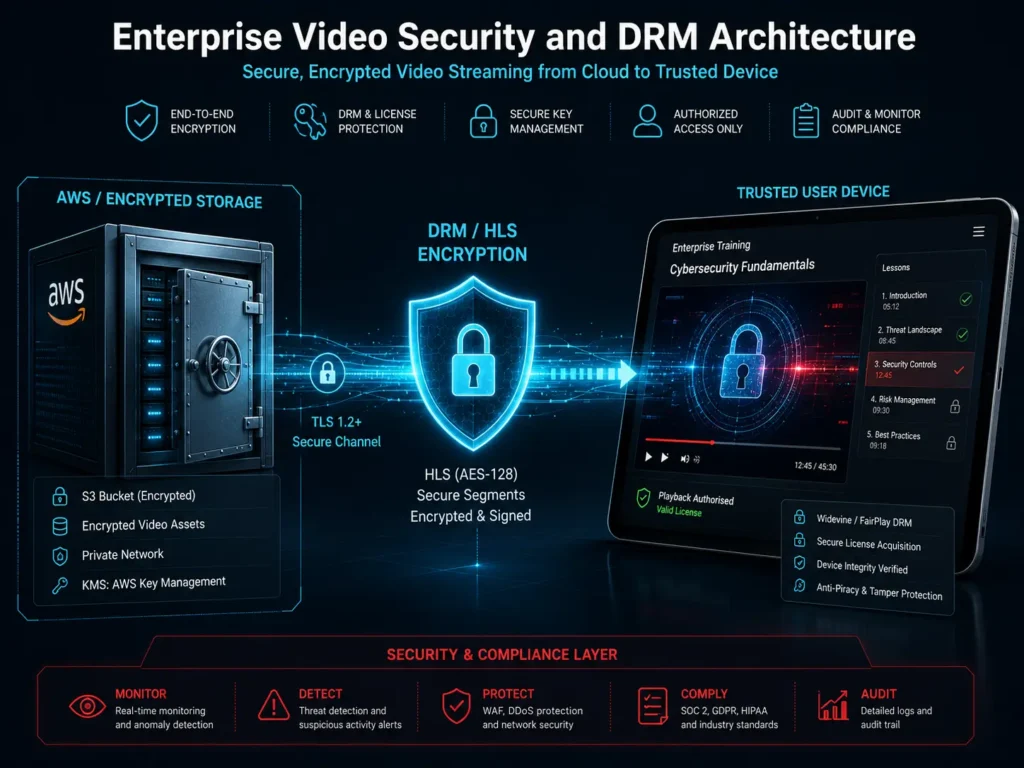
Our custom LMS development services include building proper video delivery infrastructure — cloud storage, signed URLs, and HLS streaming with token authentication. For high-sensitivity content, we set up DRM workflows through AWS MediaConvert and CloudFront that encrypt video at the segment level. Unauthorized download attempts hit a wall.
Your paying students get a fast, smooth playback experience on any device. Everyone else hits a dead end.
According to research published by HolonIQ, the global e-learning market is on a steep growth curve — which makes premium course content an increasingly attractive target for piracy and unauthorized redistribution.
Video security is not a feature you add later. It needs to be built into the architecture from the start.
5. Integrations That Connect Your Entire Operation
A learning platform that does not talk to the rest of your business creates manual work. Someone has to copy student data into your CRM. Someone has to manually trigger email sequences. Someone has to reconcile payment records with enrollment data.
Our custom LMS development services include deep API integrations that eliminate that friction. When a student completes a purchase through Stripe, the platform can automatically grant course access, enroll them in the right HubSpot sequence, and send a Slack notification to the relevant team — without anyone on your side doing anything.
We regularly build integrations with:
- Stripe, PayPal, and custom B2B invoicing systems
- Salesforce, HubSpot, and ActiveCampaign
- Google Analytics and Tag Manager
- Workday and enterprise HR platforms for employee training compliance
- Zoom and Microsoft Teams for live session scheduling
This is where custom LMS development services return the most value — not just as a course player, but as a connected operational system your entire team works within.
6. SCORM, xAPI, and Compliance for Enterprise Training
Not every enterprise training team is just uploading video files. If your instructional design team uses Articulate Storyline, Adobe Captivate, or Rise 360, those interactive modules require SCORM or xAPI to properly track learner activity and report it back to your LMS.
Our custom LMS development services include native support for these standards. Whether that means a full custom Moodle development project with SCORM 1.2 and 2004 compatibility, or a headless Next.js frontend connected to a Laravel backend with xAPI integration, we build the stack that matches your compliance requirements.
Companies in healthcare, finance, legal, and government contracting often need full audit trails for employee training completion — not just pass/fail records, but timestamped behavioral data. We engineer platforms that generate that documentation automatically and integrate with external Learning Record Stores (LRS) where required.
More detail on SCORM and xAPI compliance standards is available at the ADL Initiative, the body that maintains these specifications.
7. Frequently Asked Questions About Custom LMS Development Services
Q1: What do custom LMS development services actually include?
Custom LMS development services cover the full build of a learning platform designed around your business — including student dashboards, secure video delivery, payment gateway integration, quiz and assessment logic, certificate generation, and API connections to your CRM, HR software, or email tools.
Q2: Can you migrate our students and courses from Teachable, Kajabi, or Thinkific?
Yes. We handle end-to-end data migrations. Videos, student accounts, enrollment records, progress data, and lesson structures are all exported and mapped to your new platform. Migration is planned and tested before go-live to avoid downtime or data gaps.
Q3: Can the platform handle both subscriptions and one-time purchases?
Yes. We build the payment logic from scratch so your platform can run one-time purchases, monthly memberships, annual subscriptions, corporate bulk licenses, and cohort enrollments simultaneously — all through a single backend connected to Stripe or Braintree.
Q4: Will it work on mobile?
Every platform we deliver is fully responsive across desktop, tablet, and mobile. If your audience expects a native app experience, we can also wrap the platform as a Progressive Web App or build dedicated iOS and Android applications alongside the web version.
Q5: Why not just use a hosted LMS platform?
Hosted platforms are a reasonable way to launch fast. The problem is what happens at scale — transaction fees, data restrictions, limited customization, and no control over the platform’s future. Custom LMS development services give you full ownership of the platform, the data, and the architecture. No recurring license fees eating into your margins. No feature walls stopping your growth.
Q6: How long does the build take?
Most projects through our custom LMS development services run between 8 and 20 weeks, depending on feature scope, the number of integrations, and whether we are handling a data migration. We set a detailed milestone schedule during discovery so your team always knows where the project stands.
Empower Your Learners. Own Your Platform.
Your course content took serious time and money to build. It deserves infrastructure that protects it, performs reliably, and gives your students an experience that reflects the quality of what you made.
If your current platform feels slow, looks generic, or keeps running into walls every time you want to add something new — that is not a platform problem you can patch. It is a structural problem that only a purpose-built solution fixes.
Our custom LMS development services are built for e-learning businesses that are serious about owning their platform. No transaction fees skimming your revenue. No feature restrictions blocking your roadmap. No dependency on a SaaS company’s pricing decisions.
MarkupMarvel has delivered custom learning platforms for ed-tech startups, corporate training programs, and professional certification providers. We know exactly what it takes to move from a hosted tool to a platform you actually control.
Let us build yours.
Explore
Other Services We Provide

5 Proven Rapid MVP Development Services for Startups
In the modern software industry, the graveyard of failed startups is filled with brilliant founders...
Service Details →
Proven Managed Web Hosting Services We Offer: 7 Solutions
You just invested tens of thousands of dollars engineering a custom, high-performance web application. Do...
Service Details →
7 Reasons to Choose Custom WordPress Development
WordPress runs more than 40% of the entire internet. That single statistic gets repeated everywhere...
Service Details →