
7 Expert MERN Stack Development Services for Fast SaaS
A WordPress site or a basic PHP backend can get a product to market. What it cannot do is handle thousands of concurrent users, process real-time data streams, or serve the kind of fluid, instant interface that modern B2B users expect. When you push a traditional CMS setup beyond what it was designed for, the cracks show up fast — slow load times, database bottlenecks, session errors under traffic, and a development team spending more time patching than building.
[toc]
7 Expert MERN Stack Development Services for Fast SaaS Growth
Most web applications fail before they scale — not because the idea was wrong, but because the architecture was built for the wrong kind of growth.
A WordPress site or a basic PHP backend can get a product to market. What it cannot do is handle thousands of concurrent users, process real-time data streams, or serve the kind of fluid, instant interface that modern B2B users expect. When you push a traditional CMS setup beyond what it was designed for, the cracks show up fast — slow load times, database bottlenecks, session errors under traffic, and a development team spending more time patching than building.
MERN stack development services exist for exactly this problem. The MERN stack — MongoDB, Express.js, React, and Node.js — is a full-stack JavaScript architecture built specifically for dynamic, data-heavy, real-time web applications. It is the foundation that powers some of the most widely used SaaS platforms in the world, and for good reason.
At MarkupMarvel, we use the MERN stack to build web applications that are engineered to scale — not held together with workarounds. Whether you are launching an MVP, rebuilding a legacy system, or architecting a multi-tenant B2B platform, we build the technical foundation your product actually needs.
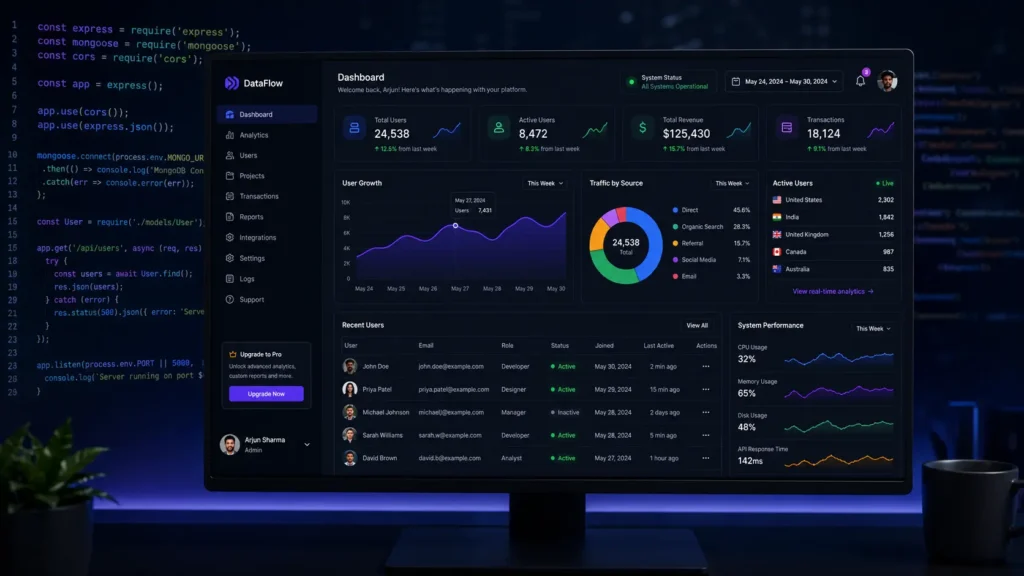
1. What the MERN Stack Actually Is — and Why It Matters
The MERN stack is not a single tool. It is a collection of four technologies that work together across the entire application — from the database layer to the user interface — all in JavaScript.
MongoDB handles data storage. Unlike traditional SQL databases that enforce rigid table structures, MongoDB stores data in flexible JSON-like documents. This makes it well-suited for applications where the data model evolves over time, or where the data itself is complex and nested. For SaaS platforms handling large volumes of user-generated data, MongoDB’s horizontal scaling capabilities — sharding across multiple servers — mean the database grows with your user base rather than against it.
Express.js sits on top of Node.js and handles server-side routing and API logic. It is minimal by design, which keeps the backend lean and gives engineers the control they need to build exactly what the application requires without fighting a heavyweight framework.
React manages the frontend. Developed and maintained by Meta, React builds user interfaces from reusable components — self-contained pieces of UI that manage their own state and render independently. When data changes, only the affected components update. The rest of the interface stays untouched. This is what gives React applications their characteristic speed and responsiveness.
Node.js is the runtime that makes JavaScript possible on the server side. Its non-blocking, event-driven architecture means it handles concurrent requests efficiently — without the thread-per-request model that causes traditional PHP servers to slow down under load.
The strategic advantage of this stack is consistency. One language — JavaScript — runs across the entire application. Your frontend engineers can read backend code. Your backend engineers understand the data structures the frontend consumes. Context switching is minimal, onboarding is faster, and the codebase stays coherent as the team grows.
According to the Stack Overflow Developer Survey, Node.js and React have consistently ranked among the most widely used technologies for web development — reflecting how broadly this architecture has been adopted across the industry.
2. Why B2B SaaS Needs Single-Page Applications
Traditional websites reload the entire page every time a user takes an action. Click a link — full reload. Submit a form — full reload. Navigate between sections — full reload. For a content site, this is acceptable. For a B2B tool where users are performing dozens of actions every hour, it creates a friction that compounds quickly.
React enables Single-Page Applications, and this architectural choice has a direct impact on user retention.
When a user loads a React SaaS application, the core application shell loads once. After that, navigation between sections, data updates, and UI changes happen dynamically — only the specific data that changed is fetched and rendered. The page does not reload. There is no visible flash, no loading spinner between every action, no latency that breaks the user’s workflow.
For high-ticket B2B platforms where user retention directly determines monthly recurring revenue, this level of responsiveness is not a nice-to-have. It is what separates tools people use daily from tools they churn off of after the trial period.
The difference is especially pronounced on dashboards, data tables, and any interface where users are managing, filtering, or updating records in real time. A well-built React SPA handles all of this without the user ever feeling like they are waiting on the software.
3. Scalable MongoDB Database Architecture
A SaaS application is only as reliable as its data layer. Poor database architecture is one of the most common reasons early-stage platforms run into performance problems as they grow — queries that were fast at 1,000 users become slow at 50,000, and the fixes get more expensive the longer they are delayed.
We design MongoDB database schemas around how your application actually queries data, not just how it stores it. The difference matters: a schema that looks clean in isolation can create performance bottlenecks in production if it requires complex joins or repeated full-collection scans to answer common queries.
For multi-tenant SaaS platforms, we architect the data isolation layer from the beginning. Depending on your compliance requirements and scale targets, this means either logical isolation — where tenant data lives in shared collections but is strictly partitioned by tenant ID — or physical isolation, where each client operates against a dedicated MongoDB database. Both approaches have trade-offs, and we work through those trade-offs with you during the architecture phase, not after launch.
For applications handling high write volumes — IoT data ingestion, event tracking, real-time logging — we implement MongoDB’s native sharding to distribute write load across multiple nodes. This keeps query performance consistent as data volume grows, rather than degrading linearly.
4. Secure Node.js and Express API Engineering
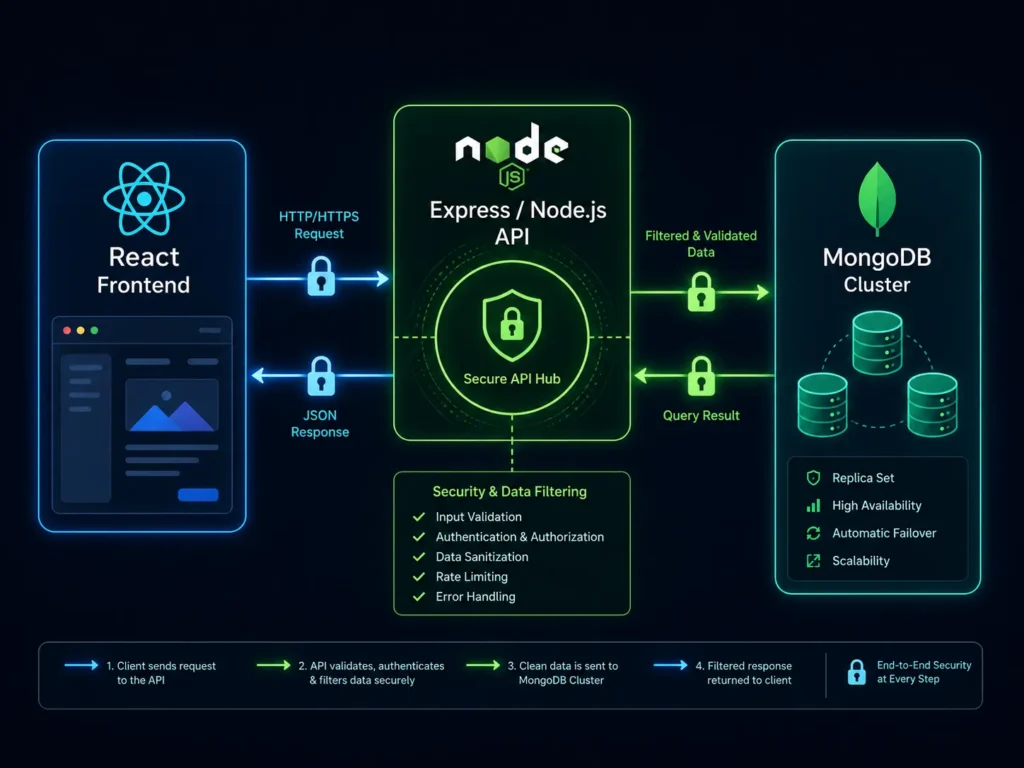
The API layer is where most of the application’s business logic lives — authentication, authorization, data validation, third-party integrations, and the rules that determine what each user can see and do. Getting this layer right is not optional.
We build RESTful APIs and GraphQL endpoints using Express.js on Node.js. Because Node.js is non-blocking, it handles concurrent requests efficiently — thousands of simultaneous API calls do not queue behind each other the way they do in synchronous server environments. For SaaS platforms with unpredictable traffic patterns, this matters.
Security is built into the architecture from the start, not added as a layer on top:
Authentication: We implement JWT (JSON Web Token) based authentication with proper token expiry, refresh token rotation, and secure storage practices. User sessions are verifiable, short-lived, and revocable.
Authorization: Role-Based Access Control (RBAC) is built into the middleware layer. Every API endpoint validates not just who the user is, but what they are permitted to do. Standard users cannot reach admin functions — not because of a UI restriction, but because the API itself rejects the request.
Data validation and sanitization: Input validation happens at the API layer before data reaches the database. SQL injection is not a concern with MongoDB, but NoSQL injection and malformed data payloads are — we handle both.
For third-party integrations, we connect your application’s backend to the services your business runs on: Stripe for subscription billing, SendGrid for transactional email, Twilio for SMS workflows, and custom API bridges for enterprise tools that require direct integration.
5. Component-Driven React Interface Development
A well-engineered backend paired with a poorly built frontend produces a product that works but frustrates the people using it. Interface quality is not cosmetic — it directly affects how quickly users learn the product, how efficiently they use it, and whether they stay.
We build React interfaces from Figma design files, translating approved designs into component-based UI with the same precision standard we apply to backend work. Every component — data tables, navigation modules, form inputs, modal dialogs, notification systems — is built to be reusable, testable, and consistent across the application.
State management is handled based on what the application actually needs. For complex global state — user session data, multi-step workflow state, real-time notifications — we use Redux or Zustand. For simpler local state, React’s built-in Context API is sufficient, and we do not add complexity that the application does not require.
The practical result for your users: actions feel instant. A user updates a record in one part of the application, and the change reflects immediately in every other component that displays that data — without a page reload, without manual refresh, without any visible lag.
6. Real-Time WebSocket Integration
Standard HTTP works on a request-response model — the client asks, the server answers, the connection closes. For most interactions, this is fine. For use cases that require live updates without user-initiated requests, it falls short.
Team collaboration tools, live chat support systems, logistics and delivery tracking, financial trading dashboards, multiplayer tools, real-time notification systems — all of these require a persistent connection between the client and the server that allows the server to push data the moment it changes.
We implement WebSocket protocols using Socket.io, which maintains a persistent two-way communication channel between the user’s browser and the application server. When new data arrives — a new message, a status change, a live metric update — the server pushes it to the relevant connected clients immediately. Users see changes as they happen, not on their next refresh.
This is not a complex add-on for the right architecture — it is a natural part of how a well-built Node.js application handles concurrent connections. We design for real-time from the beginning when the use case requires it, rather than retrofitting it into an architecture that was not built for it.
7. Cloud Deployment, DevOps, and Infrastructure
Building a strong application is one part of the work. Deploying it in a way that keeps it available, performant, and secure under production conditions is the other.
We handle full deployment to AWS or Google Cloud Platform. The specific infrastructure configuration depends on your application’s traffic patterns, compliance requirements, and growth trajectory — but the principles are consistent across every deployment we manage.
Containerization with Docker means your application runs in a consistent, isolated environment regardless of what is happening on the underlying host. The same container that runs in development runs in production, which eliminates an entire category of environment-specific bugs.
Kubernetes orchestration handles scaling. When traffic increases, Kubernetes spins up additional application containers automatically. When traffic drops, it scales back down. Your infrastructure matches your load in real time, which keeps costs predictable and performance consistent.
CI/CD pipelines automate the path from code commit to production deployment. When your engineering team ships a new feature, it moves through automated testing, staging verification, and production deployment without manual intervention at each step. This keeps release cycles short and reduces the risk of human error during deployment.
According to AWS’s infrastructure documentation, teams using CI/CD pipelines deploy changes significantly more frequently and recover from failures faster than teams relying on manual deployment processes. We build that capability into your infrastructure from launch.
Frequently Asked Questions
Q: Why choose MERN stack development services over PHP, Laravel, or Python?
The primary advantage is a consistent JavaScript environment across the full stack. Your frontend and backend speak the same language, which shortens development cycles, simplifies onboarding, and makes the codebase easier to maintain over time. Node.js also handles concurrent, real-time workloads more efficiently than traditional synchronous PHP — which matters significantly for data-heavy SaaS applications.
Q: Can a React SPA be properly optimized for SEO?
Yes. Standard client-side React has historically been difficult for search engine crawlers to index. We solve this with Next.js, which provides Server-Side Rendering (SSR) and Static Site Generation (SSG). This means Googlebot receives fully rendered HTML rather than a JavaScript shell — giving you the performance benefits of a React SPA with proper technical SEO.
Q: How do you handle multi-tenant architecture for B2B SaaS?
We architect the data isolation layer during the design phase. Logical isolation uses shared collections with strict tenant ID partitioning. Physical isolation uses dedicated databases per client. The right approach depends on your compliance requirements, expected client volume, and operational complexity. We walk through the trade-offs with you before writing a line of code.
Q: How do you secure a MERN stack application at the enterprise level?
Security is built into the architecture rather than added on top. JWT authentication with proper token rotation, RBAC middleware that validates permissions at the API level, input sanitization against injection attacks, data encryption at rest and in transit, and cloud infrastructure with environment separation between staging and production. These are standard practices in our builds, not optional add-ons.
Q: Do you provide post-launch DevOps support?
Yes. We provide ongoing infrastructure monitoring, security patching, performance reviews, and rapid incident response. For SaaS platforms, uptime is directly tied to revenue — we treat infrastructure support accordingly.
Q: How long does a MERN stack development project typically take?
An MVP with core features typically runs 8 to 14 weeks. A full-scale multi-tenant SaaS platform with third-party integrations and custom DevOps configuration is usually 16 to 24 weeks. We provide a detailed project timeline during the scoping phase so you can plan around it.
Ready to Build Your Web Application the Right Way?
Off-the-shelf software puts a ceiling on what your product can do. If you have identified a real problem worth solving — or a process inside your organization that needs a purpose-built tool — the architecture you choose in the first few months determines how far you can go without rebuilding.
MERN stack development services give you a foundation built for real scale: a database that grows horizontally, a backend that handles concurrent load, a frontend that responds like a native application, and infrastructure that adapts to your traffic automatically.
MarkupMarvel builds full-stack applications for founders and enterprise teams that need more than a template.
Explore
Other Services We Provide

E-Commerce Catalog Management: 3 Proven Ways to Scale
Growth in e-commerce comes with a problem most brands do not see coming: the sheer...
Service Details →
Multi-Vendor Marketplace Development: 7 Proven Strategies
The traditional, single-seller e-commerce model is rapidly evolving. If you look at the most lucrative,...
Service Details →
UI UX Design to Code: 7 Proven Services That Convert
A stunning UI/UX design is only as impactful as the code that brings it to...
Service Details →