7 Proven Website Revamping Services That Boost Performance
In the digital landscape, a website ages rapidly. A platform built just three to five years ago may already be suffering from code bloat, outdated user interfaces, mobile responsiveness issues, and declining search engine rankings. When your website looks dated or loads slowly, it instantly erodes brand trust and bleeds potential revenue. However, solving this requires more than just applying a fresh coat of digital paint. Slapping a new premium theme onto a deteriorating codebase is a temporary bandage that ignores the root problems of poor performance and low conversion rates.
[toc]
Website Revamping Services: Modernize Your Site Without Losing What Already Works
A website ages fast. A platform built three or four years ago can already feel sluggish, disorganized, or completely out of step with the business it is supposed to represent today.
Maybe the design no longer matches your current brand. Maybe the mobile experience crawls on a 4G connection. Maybe the backend is a pile of unused plugins, deprecated templates, and quick fixes that nobody remembers adding. Whatever the combination, the result is the same: a website that costs you customers every single day it stays online in its current state.
Most business owners recognize the problem. The mistake is in how they try to fix it.
Changing your brand colors, installing a new WordPress theme, or swapping out hero images might make things look fresher for a few months. But if the underlying structure is broken, a cosmetic update does nothing. The mechanical failures keep bleeding your revenue in the background.
Real website revamping services go much deeper. They look at your user journey, your technical SEO, your CMS architecture, your frontend code, and the conversion paths that are quietly failing your visitors. The goal is not a prettier website. The goal is a website that performs — for your users, for search engines, and for your bottom line.
At MarkupMarvel, we take underperforming, bloated websites and rebuild them into fast, focused, conversion-driven platforms. We pay close attention to what your users experience, what Google’s algorithms reward, and what your team actually needs to manage the site after we hand it over.
1. Redesign vs. Revamp: Why a Visual Update Is Not Enough
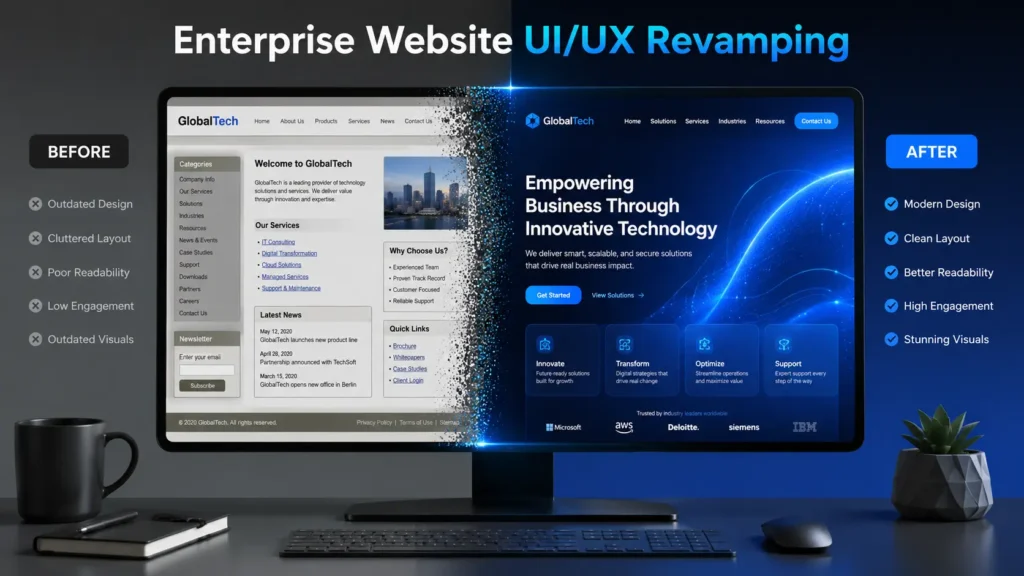
A lot of companies come to us asking for a redesign when what they actually need is a revamp. These are not the same thing, and the difference is worth understanding before you spend a dollar.
A redesign works on the surface. New fonts, updated colors, better stock photos, a cleaned-up homepage. There is nothing wrong with a visual refresh — but if your website has structural problems, a redesign is a coat of paint over a crumbling foundation. It looks better for a while. The problems do not go away.
A revamp goes underneath. It asks the questions that actually matter:
- Is the site architecture guiding users toward a sale, or scattering their attention?
- Are the core pages loading in under 2.5 seconds on a mobile connection?
- Can your team publish content without calling a developer?
- Are bloated third-party scripts killing your server response time?
- Are your calls-to-action placed where they can actually convert?
Your website is not a digital brochure. It is a sales channel that runs 24 hours a day. If it looks modern but takes four seconds to load, users leave. If the design is clean but checkout requires six extra clicks, customers abandon their carts. A proper set of website revamping services fixes both the visible and invisible problems at the same time.
2. UI/UX Modernization Built Around How People Actually Browse
Think about how much your business has changed since your website launched. You have probably refined your services, adjusted your target audience, or added products and offerings that did not exist back then. If your website still reflects a version of your business from two or three years ago, visitors feel that gap — even if they cannot articulate why.
Our website revamping services include a full UI/UX audit before any redesign work begins. We look at how users actually move through your site — where they hesitate, where they drop off, and what stops them from converting.
The objective is straightforward: reduce friction. Make the next step obvious enough that visitors do not have to think about it.
For a B2B services company, that might mean stronger trust signals on the homepage, a cleaner service grouping, and a consultation form that does not ask for twelve fields before the first conversation. For an e-commerce brand, it means faster product filtering, a simpler category structure, and a mobile checkout flow a user can complete in under two minutes.
Good UI/UX is not about animations or visual complexity. It is about getting someone from casual interest to a committed action without any unnecessary friction in the middle.
3. Codebase Refactoring and Core Web Vitals
A website can look completely fine on the surface and be a disaster underneath. This is the standard condition of most legacy sites after three or more years of accumulated changes.
A marketing manager installs several tracking scripts. A previous developer leaves unused CSS files active. Images get uploaded straight from a camera without compression. Small quick-fixes pile up year after year until the site is slow, expensive to host, and penalized by search engines.
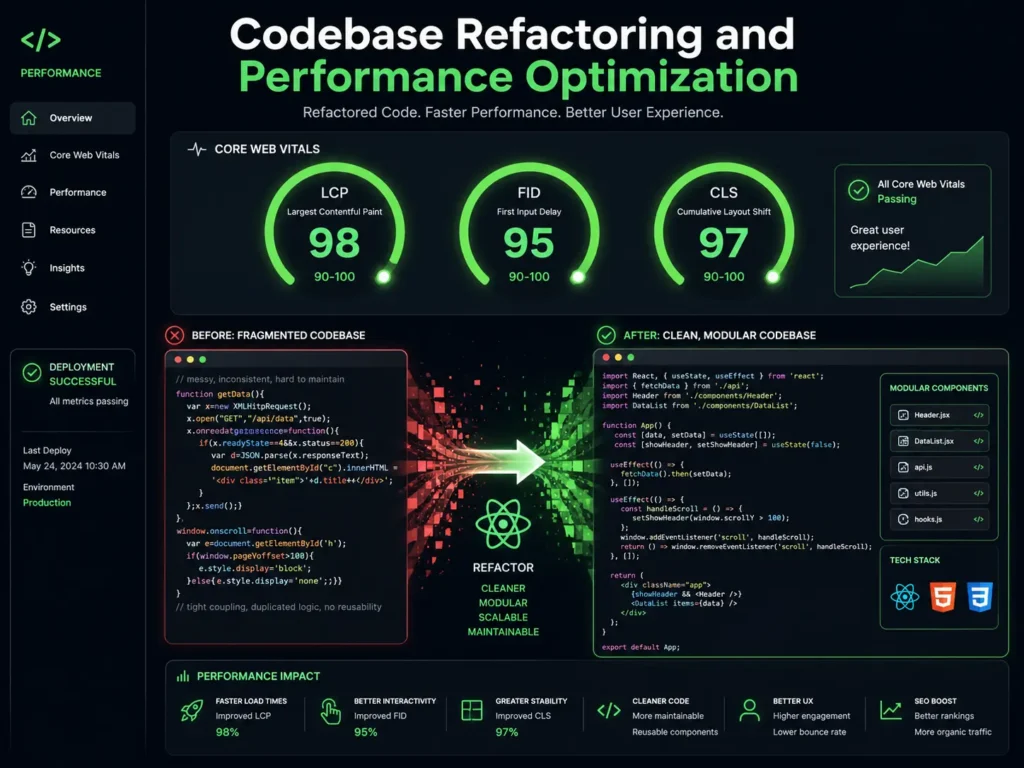
Codebase refactoring is how we fix this. During a revamp, we remove deprecated code, strip out unnecessary plugin dependencies, optimize every asset, and rebuild layouts using clean, modular frontend code. The result is a site that loads faster, costs less to maintain, and does not break every time someone updates a plugin.
We build specifically for Google’s Core Web Vitals:
- Largest Contentful Paint (LCP) — main content loads fast, not after the user has already bounced
- Interaction to Next Paint (INP) — buttons and links respond immediately when clicked
- Cumulative Layout Shift (CLS) — page elements stay in place while loading instead of jumping around
These metrics directly affect your search rankings and your user experience. A slow-loading hero section or a shifting mobile layout kills trust in the first few seconds. Our website revamping services target green PageSpeed scores without compromising the design.
4. CMS Refactoring: Do You Actually Need to Switch Platforms?
One of the first questions clients ask during a revamp is whether they need to migrate to a completely new platform. In most cases, the answer is no.
If your current CMS — WordPress, Shopify, or a custom build — still handles your team’s day-to-day needs without major friction, we do not need to replace it. We can do a deep backend cleanup, remove the heavy commercial theme running underneath everything, and build a lightweight custom frontend on top of your existing infrastructure. The result feels like a completely different website to your visitors and your team, without the risk and cost of a full platform migration.
That said, if the CMS itself is the bottleneck — fundamentally insecure, crashing under normal traffic, or blocking the features your business needs — we will move you to something better. That might mean a headless CMS with a Next.js or React frontend, or a cleaner WordPress multisite architecture. We recommend what fits your operation, not what is currently popular in developer circles.
5. SEO Preservation: Protecting the Rankings You Already Have
The most common website revamp horror story goes like this: a company launches a new site, it looks great, and two weeks later their organic traffic has dropped by 60 percent. Their agency changed URL slugs without redirects, deleted H1 tags, and wiped out years of carefully built metadata. The new site ranks for almost nothing.
This happens more often than it should. And it is entirely preventable.
Our website revamping services include a strict SEO preservation process that runs in parallel with the build — not as an afterthought. Before we write a single line of new code, we audit your current search footprint. We document every high-traffic landing page, every keyword ranking that drives revenue, and every inbound backlink that contributes to your domain authority.
According to Google’s Search Central documentation, properly implemented 301 redirects pass the full weight of your historical ranking signals to the new URL. We build and test a complete redirect map before anything goes live.
We preserve your metadata, maintain heading hierarchies, and ensure that your best-performing content lands cleanly on the new architecture. Search engines get technical clarity. Users get a faster, cleaner experience. Nothing earned gets left behind.
6. Integrations, Analytics, and Handing Over a Site Your Team Can Use
A revamped website that your marketing team cannot update without calling a developer is not a finished product. It is a different kind of problem.
Every project through our website revamping services ends with a CMS setup your internal team can actually work with — clean page builders, clear content structures, and editor roles that give the right people access to the right areas without risking the site’s integrity.
Beyond the CMS, we also set up or migrate your core analytics and tracking:
- Google Analytics 4 and Google Search Console configuration
- Conversion tracking via Google Tag Manager
- Heatmap and session recording tools for ongoing UX monitoring
- Third-party CRM and email marketing integrations where required
You should be able to see how the new site is performing from day one. We make sure the data infrastructure is in place before we hand over the keys.
For further reading on website performance benchmarks, Google’s Web Vitals guidance provides the technical standards we engineer toward on every project.
7. Frequently Asked Questions About Website Revamping Services
Q1: What is actually included in website revamping services?
Website revamping services cover the full modernization of your digital platform — not just the visual layer. This includes codebase refactoring, Core Web Vitals optimization, UI/UX restructuring for better conversions, SEO preservation with 301 redirect mapping, CMS cleanup, and analytics configuration. The result is a site that performs better for users, ranks better in search, and is easier for your team to manage.
Q2: Will we lose our Google rankings after the revamp?
Not when it is done correctly. We audit your full site architecture before making any changes, document every ranking page and keyword, and build a complete 301 redirect map that transfers your historical authority to the new structure. Metadata and heading hierarchies are preserved throughout the build.
Q3: Do we have to switch to a new CMS?
No. If your current platform still works for your team, we can refactor and rebuild on top of it. We only recommend a CMS migration when the existing backend is actively creating problems — security vulnerabilities, repeated crashes, or hard limits on what the site can do.
Q4: How is a revamp different from a standard website redesign?
A redesign is cosmetic — new fonts, colors, and images. A revamp is structural. It fixes the things a redesign never touches: slow server response times, broken mobile flows, bloated databases, poor accessibility, and SEO gaps that are quietly costing you traffic every month.
Q5: How long does a revamp take?
Most projects through our website revamping services run between 4 and 8 weeks for a standard corporate or mid-sized e-commerce site. That timeline covers the initial audit, UI/UX wireframing, custom frontend development, codebase refactoring, SEO preservation, and QA testing before go-live.
Q6: Can you revamp a site that was not built by your team?
Yes. We regularly take over websites built by previous developers or agencies. We start with a full technical audit of what exists, document the current state, and build a revamp plan from there. The previous build history does not limit what we can do.
Your Website Should Be Working For You, Not Against You
Every day your current site stays online in its broken state is a day you are paying for traffic that does not convert. Slow load times, confusing navigation, and a checkout flow that loses customers at the last step — these are not minor inconveniences. They are revenue problems.
A proper revamp does not start with picking new colors. It starts with understanding what is broken and why. Then it fixes the foundation before touching anything visible.
Our website revamping services are built for businesses that are serious about their digital performance. We handle the technical depth — the Core Web Vitals, the SEO preservation, the codebase cleanup — so the finished product is not just better looking, but genuinely better at doing its job.
MarkupMarvel has revamped corporate sites, e-commerce platforms, and SaaS products across a wide range of industries. We know where legacy websites fail, and we know how to fix them without breaking what already works.
Explore
Other Services We Provide

5 Proven Rapid MVP Development Services for Startups
In the modern software industry, the graveyard of failed startups is filled with brilliant founders...
Service Details →
E-Commerce Catalog Management: 3 Proven Ways to Scale
Growth in e-commerce comes with a problem most brands do not see coming: the sheer...
Service Details →
7 Reasons to Choose Custom WordPress Development
WordPress runs more than 40% of the entire internet. That single statistic gets repeated everywhere...
Service Details →